This recording uses 24-bit technology, which offers a dynamic range up to 48 dB greater and up to 256 times the resolution of standard 16-bit recordings.
Composition History
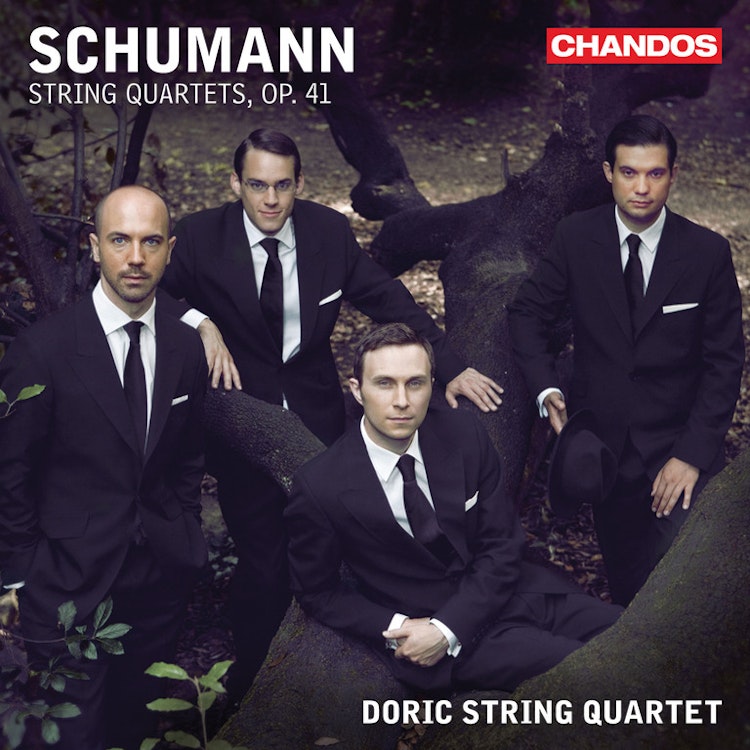
Schumann's three String Quartets, Op. 41, were composed during a period of intense creative activity in the second half of 1842, with the first two sketched in June and the third in July.
Performer Biography
The Doric String Quartet won First Prize in the Osaka International Chamber Music Competition in Japan and Second Prize at the Premio Paolo Borciani International String Quartet Competition in Italy in 2008.
Composer Biography
Robert Schumann's early works included two movements of a symphony, three unfinished piano concertos, and a piano quartet, along with sketches in other genres like the string quartet.
Composer's Artistic Vision
Schumann was deeply influenced by Beethoven's late quartets, which he considered to mark the 'furthest limits yet attained by human art and imagination'.
Compositional Technique
The first movement of Schumann's String Quartet No. 1, Op. 41 No. 1, features an unconventional tonal scheme where the Allegro proceeds entirely in F major, despite the piece being 'in' A minor.
Compositional Technique
Schumann's Op. 41 quartets are a tonally interconnected cyclic composition, with the unconventional tonal scheme of No. 1 engaging the tonic centers of the other two quartets.
You might also enjoy...
Spohr: String Quartets Vol. 1
Adès / Nørgård / Abrahamsen
Mendelssohn: String Quartet in a Minor, Op. 13 / Berg: Lyric Suite