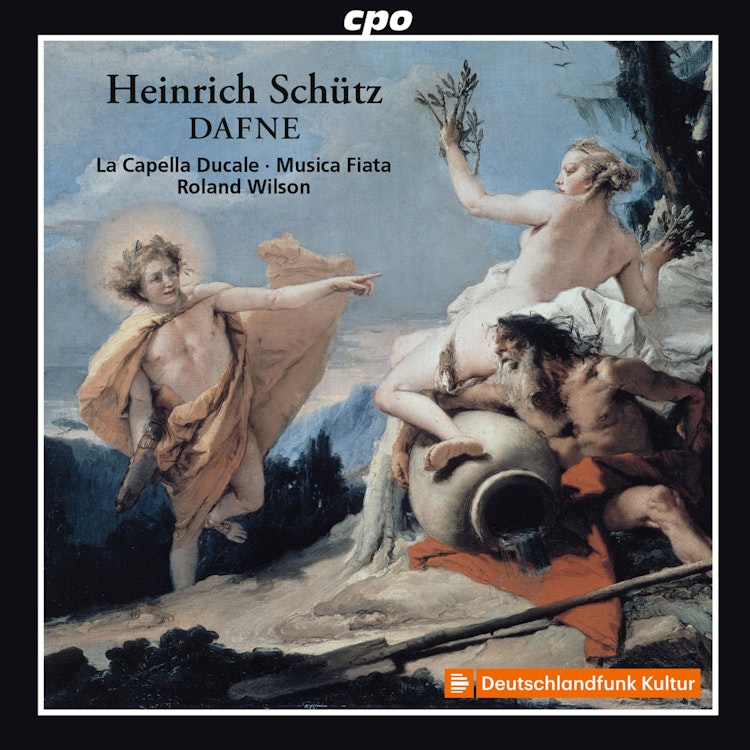
The reconstruction of Dafne also includes music from Heinrich Schütz's contemporaries, such as Johann Nauwach's villanellen, Biagio Marini's ritornelli, and a lament by Alessandro Grandi.
Album & Artwork
The Funk Foundation, a private non-profit organization, supports cultural projects like this album, particularly those that make lesser-known classical works accessible to a wider audience.
Performer Biography
Roland Wilson, the director of Musica Fiata, initially studied trumpet but developed an interest in 16th and 17th-century music, teaching himself the cornett and pursuing further studies in The Hague.
Composition History
Although the libretto for Dafne by Martin Opitz was published, almost all of Heinrich Schütz's original music for the opera has been lost, with the exception of a gagliarda by Carlo Farina.
Composition History
Heinrich Schütz's opera Dafne, with a libretto by Martin Opitz, was first performed on April 13, 1627, in Torgau, Germany, as part of a wedding celebration.
Performer Biography
Musica Fiata, the ensemble on this recording, was founded in 1976 to perform 16th and 17th-century music on historical instruments, focusing on a 'speaking playing style' and characteristic sound.
Compositional Technique
The reconstruction of Dafne on this album incorporates about a dozen mostly secular works by Heinrich Schütz, making up roughly half of the opera.