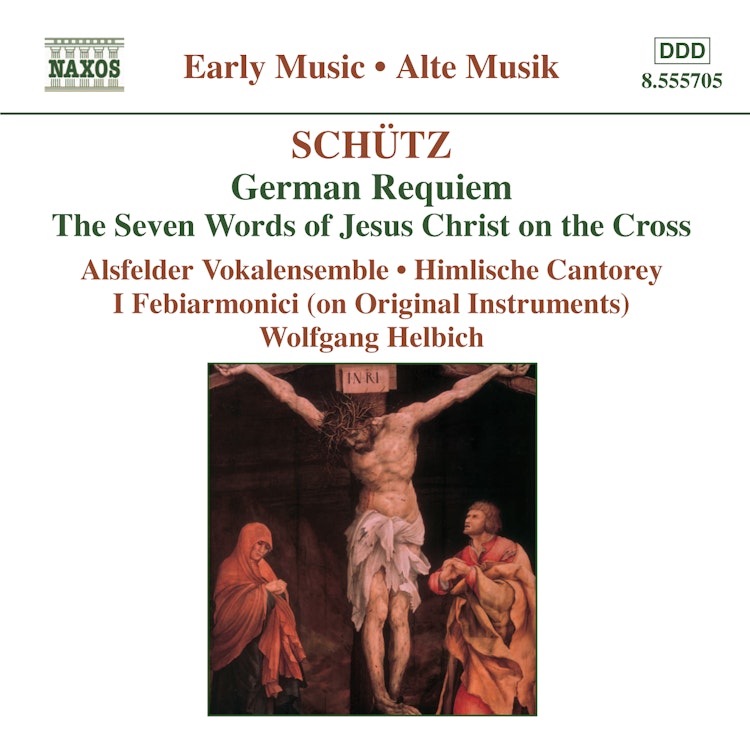
Schutz: German Requiem / Seven Last Words of Christ
12/22/2004, 11 Tracks, 52:49
Featuring
Bettina Pahn
Veronika Winter
Henning Voss
Henning Kaiser
Jan Kobow
Ralf Grobe
Ulrich Maier
Beate Rollecke
Wolfgang Helbich
Alsfelder Vokalensemble
I Febiarmonici
Heinrich Schütz
Did you know?
1/7
Recording & Production
The ensemble I Febiarmonici, founded in 1998, is a period instrument ensemble that takes inspiration from 18th-century Italian musical troupes known for their quality and love of travel.
Compositional Technique
The first movement of Musicalische Exequien, titled 'Concert in Form einer teutschen Begräbnis-Missa', is for six singers with organ, with sections for solo voices alternating with chorale-based sections reinforced by other singers.
Composer Biography
Schütz studied in Venice with Giovanni Gabrieli, a renowned composer, and returned to Germany to join the Landgrave's Hofkapelle.
Composition History
Schütz's Musicalische Exequien was written for the funeral of Prince Heinrich Posthumus of Reuss, who had arranged his own funeral ceremonies and chosen the texts for the work before his death.
Composer's Artistic Vision
Schütz was a composer of great importance, linking the traditions of Gabrieli's Venice with the music of Protestant Germany.
Composer Biography
Heinrich Schütz, the leading German composer of the 17th century, lived through one of the most difficult periods in German history, the Thirty Years War.
Compositional Technique
In 'The Seven Words of Jesus Christ on the Cross', the words of Christ are sung by the second tenor and accompanied by two upper instruments and continuo, a procedure followed throughout the work.