For Lutheran composers like Schütz, the vision of death was one of great serenity and trust in redemption, viewing it as a liberation from earthly suffering.
Historical Context
Prince Heinrich Posthumus von Reuss, the commissioner of Musicalische Exequien, was a skilled diplomat and humanist whose advice was frequently sought.
Album & Artwork
The album features photos of the sarcophagus of Heinrich Posthumus Reuss, which was rediscovered in 1995 and contains liturgical texts chosen by him.
Composition History
Heinrich Schütz's Musicalische Exequien was commissioned by Prince Heinrich Posthumus von Reuss, who had meticulously planned his own funeral service.
Composition History
Schütz composed two versions of "Herr, nun läßest du" for six voices in 1656 for the funeral of Georg I, Elector of Saxony, his patron for over forty years.
Instruments
The basso continuo for Musicalische Exequien was intended for organ, with the term "Violon" referring to a violone, a bass string instrument.
Compositional Technique
Schütz's Concert in Form einer Teutschen Begräbnis-Missa systematically alternates between solo voice sections and a six-part Capella, for which he recommended doubling the number of singers.
You might also enjoy...
Schütz, Praetorius, Schein & Demantius: 17th Century Funeral Music
Choral Concert: Schutz Academy - SCHUTZ, H. / PRAETORIUS, M. / SCHEIN, J.H. / DEMANTIUS, C.
Schütz, Praetorius, Schein & Demantius: 17th-Century Funeral Music
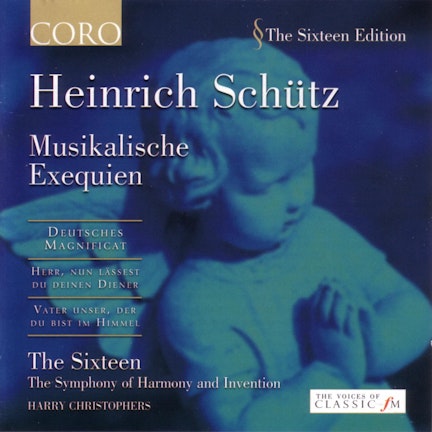
Heinrich Schütz: Musikalische Exequien
Motetten & Kantaten der Bach Familie
Monteverdi / Schütz / Gabreli: Motets
Cantus Cölln-Edition
St Mark's & Venice: Sacred Music at the Heart of the Baroque Revolution
Motets
Splendours of the Gonzaga. Sacred Music from Wert to Monteverdi