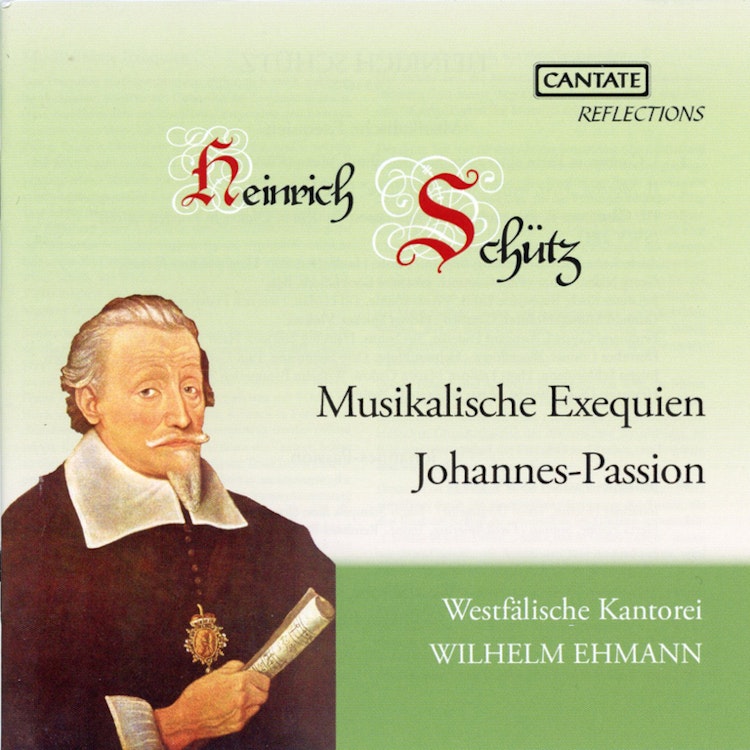
For this recording, a theorbo (bass lute) and a 16ft pitch violone were used, as Schütz himself mentioned these instruments as important for the continuo group in his works.
Composer Biography
Heinrich Schütz was in his 80th year when he composed the St. John Passion, combining traditional and modern elements in his 'Historia' works.
Composition History
The texts for the first part of "Musikalische Exequien" were Bible verses and hymn stanzas that Prince Heinrich Posthumus von Reuß had engraved on his coffin during his lifetime.
Compositional Technique
Schütz's "Musikalische Exequien" contains over a hundred musical 'images' where tone and sound patterns conform to the meaning of the words, such as the repetition of notes for 'naked' or rests for 'taken away'.
Interpretation
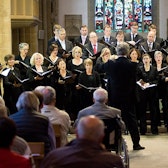
This recording of "Musikalische Exequien" uses 'Favoritsänger' (soloists) as the central element, with additional 'Capell-Sänger' (tutti-singers) and instrumental ensembles for choral passages, following Schütz's own performance instructions.
Composition History
Heinrich Schütz's "Musikalische Exequien" was commissioned by Heinrich Posthumus von Reuß, a prince who asked Schütz to compose music for his own funeral.
Composer's Artistic Vision
In "Musikalische Exequien," Schütz used the simplicity of the composition and diatonic harmony to reflect security, steadfast faith, and peace.
You might also enjoy...
Bach: Magnificat; 3 Motets
Bach: Cantata No 147; The Six Motets; Chorales & Chorale Preludes for Advent and Christmas
Festive Arias (Live)
Bach: 6 Motets BWV 225-230
Bach 333: Complete Motets
Aria - Bachs schönste Arien
Schutz: German Requiem / Seven Last Words of Christ
J.S. Bach, J.C. Bach & Schmelzer: Choral Works (Live)