Scriabin's sonatas feature thematic recurrences between movements and self-quotations, suggesting a single, intricate work embracing Sonatas Four through Ten as phases of a spiritual experience.
Compositional Technique
The performing directions in Scriabin's sonatas change from Italian to French from the Sixth Sonata onwards and multiply out of proportion, often bordering on delirium and mystical ecstasy.
Composer's Artistic Vision
Scriabin's sonatas reflect his artistic journey from the romantic gestures of Liszt to a more symbolic esotericism, influenced by the philosopher and mystic Vladimir Solovyov.
Compositional Technique
Scriabin's later sonatas show increasing complexity: the Fourth Sonata has three staves in some passages, the Seventh has four, and ornamentation, especially trills, grows vertiginously.
Composer's Artistic Vision
Scriabin intended his musical experience to be a vehicle for a supreme experience and spiritual 'regeneration' for both performer and audience, believing 'Beauty will save the world'.
Compositional Technique
From the Fifth Sonata onwards, Scriabin removed accidentals in the clef and metronome indications, inviting performers to find the psychological and physical durations within themselves.
Composer Biography
Alexander Scriabin's ten piano sonatas, to which he assigned an opus number, span from 1891 during his Moscow Conservatory studies to 1913, shortly before his death.
You might also enjoy...
Rachmaninoff: Piano Sonatas Nos. 1 & 2
Medtner: Complete Piano Sonatas, Vol. 2
Balakirev, Glazunov, Kosenko: Russian Piano Sonatas Vol. 1
Rachmaninov, Prokofiev & Serocki: Sonaty
20th Century Piano Sonatas Vol. 6
Scriabin: Piano Sonatas Nos. 3, 4, 5 & 9
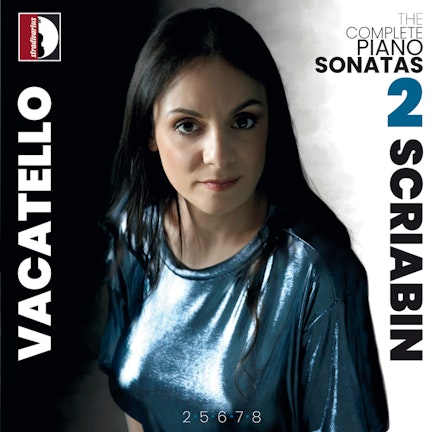
Scriabin: The Complete Piano Sonatas Vol.II
Prokofiev, S.: Piano Sonatas (Complete) / Visions Fugitives
Dmitri Shostakovich: Piano Sonata No. 2 in B Minor; Frank Bridge: Piano Sonata