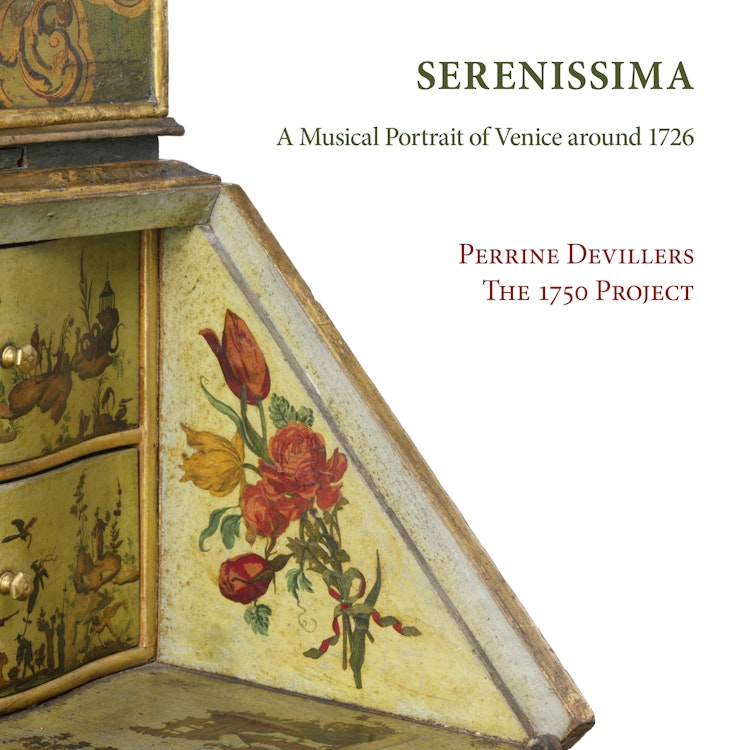
Serenissima: A Musical Portrait of Venice Around 1726
1/8/2021, 23 Tracks, 1:16:12
Featuring
Benoît Laurent
Jan Van den Borre
Salomé Rateau
Jacek Kurzydło
Nadine Henrichs
Mathilde Wolfs
Korneel Bernolet
Perrine Devillers
The 1750 Project
Antonio Vivaldi
Domenico Scarlatti
Nicola Antonio Porpora
Giuseppe Sammartini
Did you know?
1/7
Album & Artwork
This album, "Serenissima," is the first episode of "The 1750 Project," which explores the musical life of a city at a key historical juncture between 1720 and 1750.
Instruments
While voice and violin dominated Venetian musical life, other instruments like the flute, oboe, and harpsichord also played significant roles, with many Venetian harpsichords preserved from the era.
Historical Context
Music was omnipresent in Venice around 1726, with people singing in squares, streets, and canals, and attending private musical evenings, church services, and seven large opera houses.
Historical Context
Around 1726, Venice was experiencing a turning point in music history, with the meeting of two different styles: the dominant force of Antonio Vivaldi and the newly arrived Neapolitan composer Nicola Porpora.
Compositional Technique
The album features works illustrating the emerging 'style galant,' Rococo, or preclassical style, which Nicola Porpora introduced to Venice and which Antonio Vivaldi quickly adapted to.
Historical Context
Venice in 1726 was unique, with a republican political system, extreme freedom of morality, and a police force that spied on everyone.
Historical Context
The album focuses on Venice around 1726, a time when the city was a musical metropolis, despite economic decline, and a compulsory stop for nobles and musicians on their Grand Tour.
You might also enjoy...
Winter's Delights - Early Christmas Music and Carols from the British Isles
Souvenirs d'Italie
Vivaldi: Sonatas for Wind Instruments
Gelosia! - Italian Cantatas
Platti: Flute Sonatas, Op. 3
Chamber Music (Baroque) - Falconieri, A. / Merula, T. / Cabanilles, J. / Storace, B. / Castello, D. / Marais, M. (Folias Festivals)
Telemann: Cantatas & Sonatas
Bach: Concertos for Recorder, Vol. 2
Torri: Trastulli & Arias – Entertainment for the Bavarian Court
Telemann, G.P.: Essercizii Musici - Solos and Nos. 1-6