Shostakovich: Cello Sonata in D Minor, Op. 40 & Viola Sonata, Op. 147
10/23/2020, 7 Tracks, 1:02:00
Featuring
Veit Hertenstein
Minze Kim
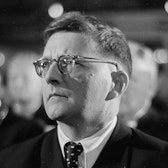
Dmitri Shostakovich
Did you know?
1/7
Composition History
Shostakovich composed his last work, the Sonata for Viola and Piano op. 147, one month before his death, and he did not live to see its premiere.
Composer Biography
Dmitri Shostakovich, a Soviet composer, lived through significant political upheaval in Russia, including the February Revolution, the founding of the Soviet Union, the Stalin era, and World War II.
Composer's Artistic Vision
Shostakovich aimed to use stylistic resources from Western European music to promote the ideals of the Russian revolution, but this conflicted with the 'Socialist Realism' demanded by Stalin's cultural officials.
Compositional Technique
In the last movement of his Viola Sonata op. 147, Shostakovich pays tribute to Beethoven by writing a fantasia inspired by the first movement of Beethoven's 'Moonlight Sonata'.
Critical Reception
Shostakovich's 'modern' operas, such as 'The Nose' and 'Lady Macbeth of Mtsensk', were met with bewilderment and led to accusations of 'left-deviant' and 'petit-bourgeois decadent' attitudes in Pravda articles.
Performer Biography
Violist Veit Hertenstein, who arranged the viola part for the Op. 40 sonata on this recording, is a Professor for Viola at the Musikhochschule Detmold and the Royal Northern College of Music in Manchester.
Composition History
Shostakovich's Sonata for Violoncello and Piano in D minor op. 40, written in 1934, was his first major chamber work and premiered in Moscow the same year.
You might also enjoy...
Viola in Exile
Schubert, Shostakovich & Pártos
Visages
Melodies
Vieuxtemps: Complete Works for Viola
Schubert: Arpeggione Sonata, D. 821 & Lieder ohne Worte for Viola and Piano
Liviabella - Rota: Viola Sonatas
past forward · Stylianou: Sonatas for Viola and Piano Nos. 1 & 2
Voices from the Homefront: American Viola Works from the 1940s