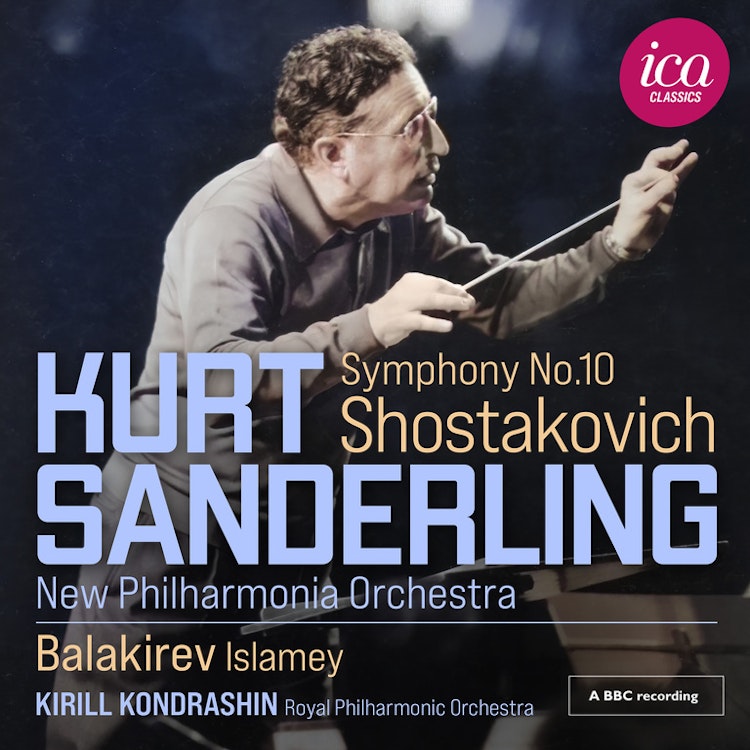
Mily Balakirev's Islamey, a piano piece on this album, is considered one of the most difficult in the entire piano repertoire and is a prime example of 'Orientalism' in Russian music.
Compositional Technique
Shostakovich's Symphony No. 10 extensively uses his musical 'signature' D-S-C-H (notes D, E flat, C and B natural) to affirm his personal identity and artistic struggle.
Composer's Artistic Vision
Dmitri Shostakovich, the composer of Symphony No. 10, was seen by conductor Kirill Kondrashin as 'the moral conscience of music in Russia,' with his music inseparable from his life events.
Composition History
Shostakovich began writing his Symphony No. 10 only five months after the death of dictator Joseph Stalin in 1953, completing it in less than three months.
Performer Biography
Kurt Sanderling, one of the conductors on this album, fled Germany for the USSR in 1936 to escape the Nazi regime, which had removed him from his post as a 'non-Aryan'.
Critical Reception
After its American premiere in 1954, The New York Times critic Olin Downes described Shostakovich's Symphony No. 10 as 'powerful, outspoken and at times grossly impolite.'
Performer Biography
Kirill Kondrashin, the other conductor on this album, defected to the West in 1978, stating his artistic freedom was being stifled in the USSR.
You might also enjoy...
Lyatoshynsky: Symphony No. 1 / 'Grazhyna', Op. 58
Lyatoshynsky: Symphony No. 1 / 'Grazhyna', Op. 58
Lyatoshynsky: Symphony No. 1 & Grazhyna
Juon: Orchestral Works, Vol. 1
Bernstein Conducts Hindemith (Remastered)
Saint-Saëns: Carnival of the Animals & Symphony No. 3, "Organ Symphony"