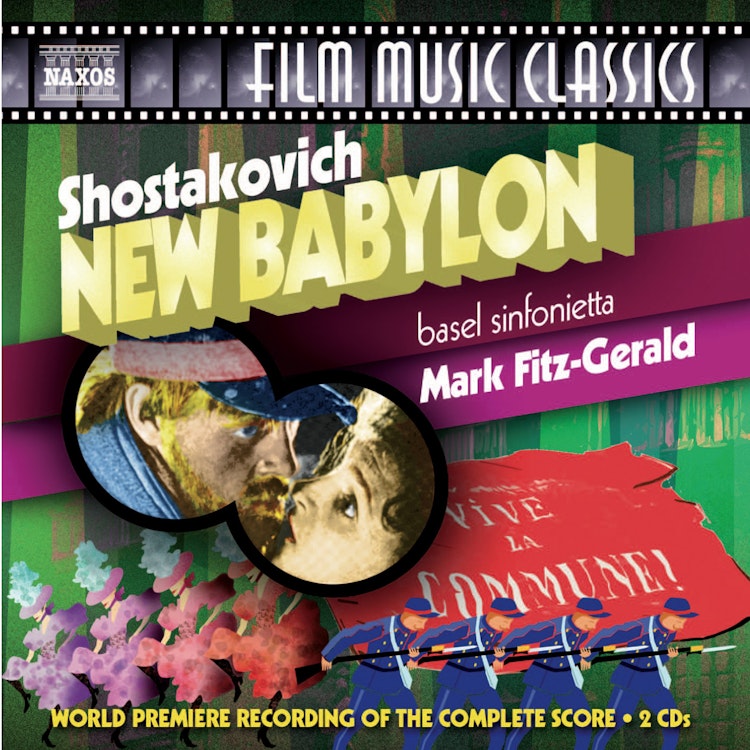
The premiere of New Babylon was a scandal, with the music deemed unplayable and 'non-cinematic' by its first conductor, leading to its withdrawal after only a few performances.
Composer's Artistic Vision
Shostakovich's score for New Babylon was designed to counterpoint rather than illustrate the film's imagery, linking with the inner meaning rather than external action.
Instruments
Shostakovich's score for New Babylon calls for the use of a flexatone, a rare percussion instrument popular in 1920s variety shows, often used to depict characters in a state of delirium.
Composition History
Shostakovich composed the music for the film New Babylon in late 1928, with a tight deadline to deliver the piano score by February 1st and the full score by March 1st, 1929.
Compositional Technique
The score for New Babylon features a striking counterpoint of the French national anthem 'La Marseillaise' and the 'Can-can' from Offenbach's Orpheus in the Underworld, reminiscent of a passage in Dostoevsky's The Devils.
Recording & Production
The original score for New Babylon was considered lost for over 45 years until a complete set of parts was found in the Lenin library in Moscow after Shostakovich's death in 1975.
Recording & Production
This recording of Shostakovich's New Babylon is the first complete recording of all surviving music from the original 'lost' manuscript full score.
You might also enjoy...
Trimpin: Above, Below and in Between (Live)
Laudamus
Reise in Die Nacht
Minkus-Lanchbery: La Bayadère
Schulz: Peters Bryllup
Changeless
Sierra: Sinfonia No. 3
Tomasini: Baryton Trios
Weingartner: Strings Quartets, Vol. 2
Roukens: Concerto for Two Pianos and Orchestra "In Unison": Neon Toccata
Happy Birthday Variations
Mozart: Requiem KV 626 - Version For String Quartet by Peter Lichtenthal