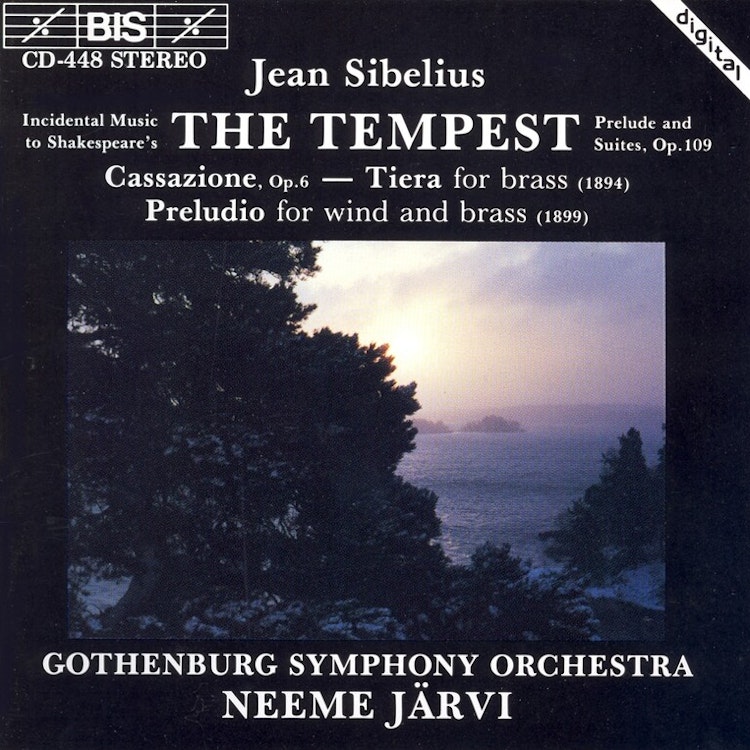
Sibelius's Tiera for brass septet and percussion, Op. 91 No. 3, derives its name from the Finnish national epic Kalevala, where Tiera is a comrade-in-arms of the hero Lemminkäinen.
Composer's Artistic Vision
Sibelius's incidental music to Shakespeare's The Tempest, Op. 109, is his largest and arguably greatest theatrical score, reflecting his ability to identify with characters like Prospero, Ariel, and Caliban.
Recording & Production
This album is part of an acclaimed series of recordings by the Gothenburg Symphony Orchestra, conducted by Neeme Järvi, featuring the complete orchestral music of Jean Sibelius.
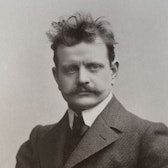
Composer Biography
Though Sibelius rarely composed for ensembles without string instruments, he had an early interest in Wagner, which is evident in his Preludio for wind and brass.
Composition History
Sibelius's Cassazione, Op. 6, was composed in haste in early 1904 and premiered under his own baton on February 8th of that year, alongside the first version of his Violin Concerto.
Performer Biography
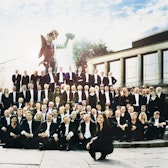
The Gothenburg Symphony Orchestra, one of Scandinavia's oldest, was founded in 1905 and has hosted famous conductors like Jean Sibelius, Carl Nielsen, Bruno Walter, and Herbert von Karajan.
Compositional Technique
Unlike 18th-century cassations, Sibelius's Cassazione, Op. 6, is in a single movement, though it contains distinct sections, with the last resembling the march often found at the end of a classical cassation.
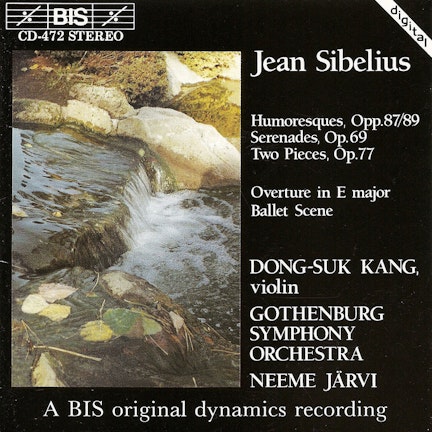
You might also enjoy...
Sibelius: Symphony No. 7 / Kuolema: Incidental Music / Night-Ride and Sunrise