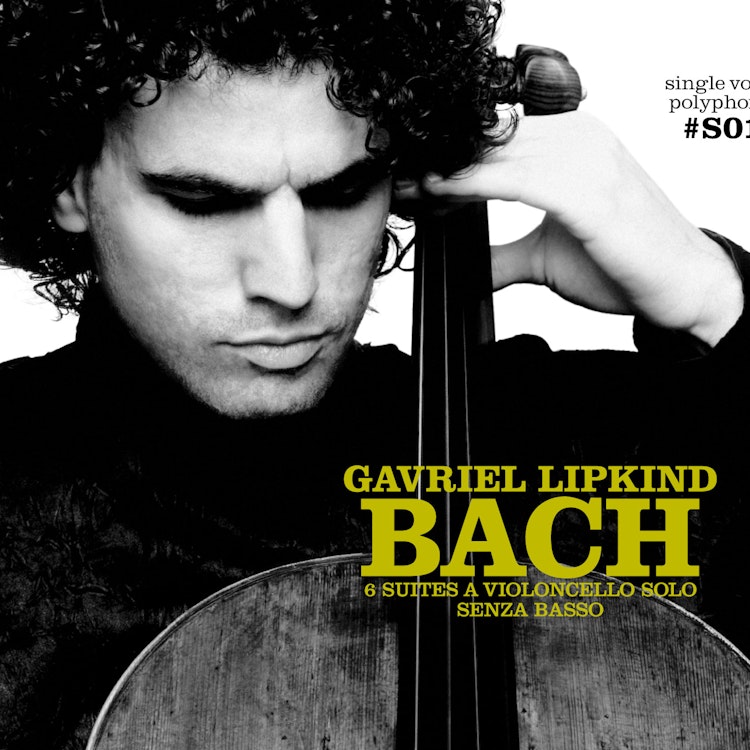
Single Voice Polyphony Vol.1 – J. S. Bach: Six Suites for cello solo
1/1/2006, 36 Tracks, 2:36:24
Featuring
Gavriel Lipkind
Johann Sebastian Bach
Did you know?
1/7
Composer's Artistic Vision
Bach's cello suites can be understood as 'program music' with an underlying religious 'libretto', reflecting his complete absorption in the Christian model of the world.
Compositional Technique
The cello suites cycle is structured in a 'sextuple macro-proportion', meaning it is based on the number six, which is the smallest common denominator of the primal proportions of two (dualism) and three (Trinity).
Instruments
Gavriel Lipkind plays an enigmatic Italian cello from around 1670-1680, erroneously labeled 'Aloysius Michael Garani (Bologna, 1702)', which is known as 'The Zihrhonheimer Cello'.
Performer Biography
Gavriel Lipkind, the cellist on this recording, began playing Bach's cello suites as his very first music on the instrument.
Compositional Technique
Bach's entire musical repertoire, including the cello suites, can be seen as an interrelation of triple and dual proportions, derived from the Christian dualistic philosophy and the Trinity.
Recording & Production
This recording is the first of several volumes to be released under the title 'Single-Voice Polyphony', a term describing the mental co-existence of multiple voices within a single musical line.
Composition History
The cello suites were 'rediscovered' much later than Bach's violin cycle, leading to analyses often based on the already familiar violin music.
You might also enjoy...
J.S. Bach: The Cello Suites
Bach: Suites for Solo Cello Nos 1 - 6
J.S. Bach: The 6 Cello Suites
Bach: 6 Cello Suites
J.S. Bach: Complete Cello Suites (The 2023 Sessions)
Bach: 6 Suites for Solo Cello, BWV 1007-1012
Bach: The 6 Suites for Solo Cello
BACH · CELLO SUITES
Bach: Cello Suites
Bach: Cello Suites, BWVV 1007-1012
Bach: Cello Suites
Bach, J.S.: Cello Suites Nos. 1-6, BWV 1007-1012 / Flute Partita (Arr. for Cello Piccolo)