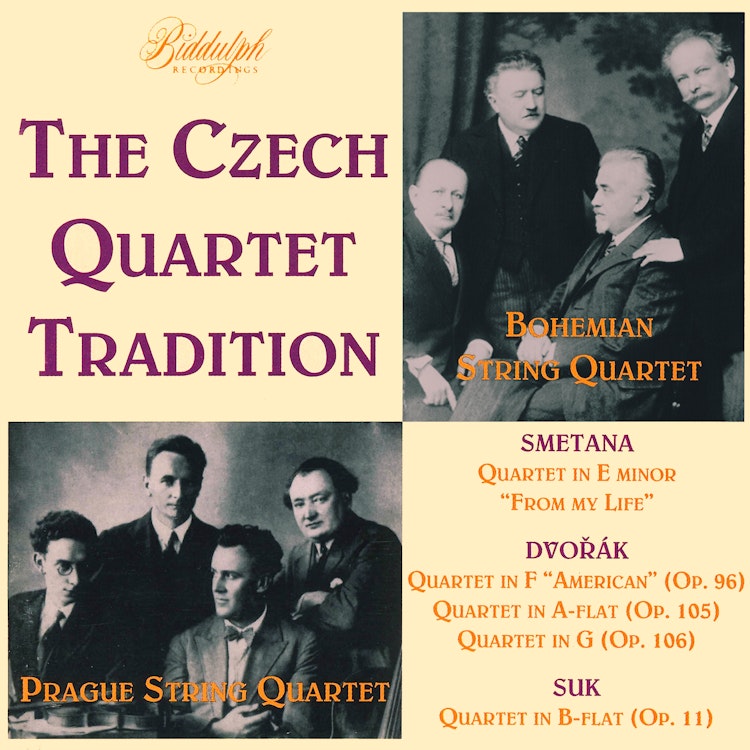
The Bohemian Quartet used gut strings and employed little or no vibrato, reflecting the best of the 19th-century school of playing.
Interpretation
The Prague Quartet's recordings are notable for their refusal to use vibrato as a shield for intonation, emphasizing rhythmic perception and a 'daring pesante fashion' in their playing.
Performer Biography
Miloš Sádlo, the cellist for the Prague Quartet, began learning the cello in his mid-teens and took his teacher's surname in gratitude.
Performer Biography
The Bohemian Quartet, formed in 1891, was composed of players of equal skill, a departure from previous ensembles that featured a powerful leader and three less prominent musicians.
Recording & Production
This album includes all the electric records made by the Bohemian Quartet for Deutsche Grammophon in the late 1920s, released on the export Polydor label.
Performer Biography
Josef Suk, the second violinist of the Bohemian Quartet, was the son-in-law of composer Dvořák, and Oskar Nedbal, the violist, was a favored interpreter of Dvořák's works.
Performer Biography
Jiří Herold, who became the violist for the Bohemian Quartet, was also a skilled instrument maker and repairer, with 43 violins, ten violas, and two cellos of his creation still surviving.
You might also enjoy...
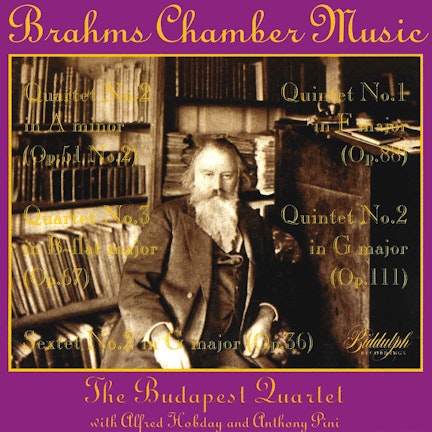
Brahms: Chamber Music
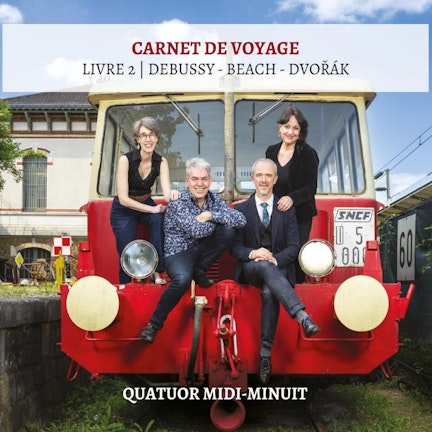
Carnet de voyage, Livre 2, Debussy-Beach-Dvořák
Schubert & Brahms: Chamber Works
Meyer: String Quartets Nos. 9, 11 & 12
Streichquartette 1 und 2
Beethoven: String Quartets Nos. 14 & 15
Brahms: Quintettes et sextuors à cordes (Intégrale musique de chambre), Vol. 2
Dvorák: String Quartet No.12 In F Major, Op.96 - "American", B.179 / Bruckner: String Quintet In F Major
Johannes Brahms - Piano Quintet in F minor Op. 34, String Quartet in A minor Op. 51 No. 2
Schubert: String Quintet in C Major, Op. 163, D. 956 - Brahms: String Sextet No. 1 in B-Flat Major, Op. 18
Dmitri Shostakovich: String Quartets Nos. 10, 11, 12 & 13
Brahms: String Sextets (Live from Aix Easter Festival 2016)
Brahms: String Quintet No. 1 in F Major, Op. 88 & No. 2 in G Major, Op. 111