The period around 1890 saw an increased popularity of 'L-portamento' (sliding on the last finger) in violin playing, which influenced Squire's compositions.
Performer Biography
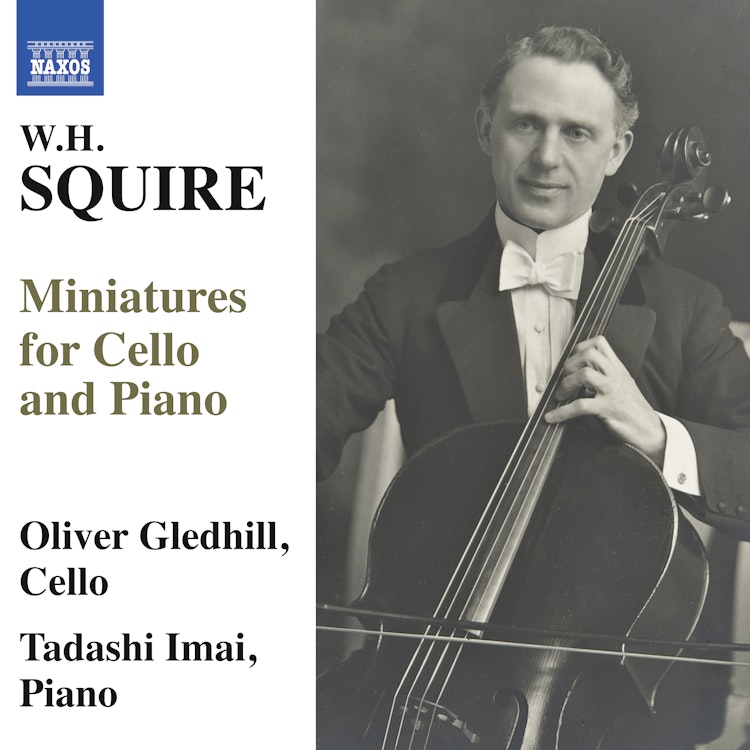
Oliver Gledhill, the cellist on this album, discovered a family connection to W.H. Squire through his doctoral research, as Squire taught his maternal grandfather's adopted son.
Composition History
Many of W.H. Squire's cello miniatures were written with three contemporary audiences in mind: Associated Board cello grade examinations, the Promenade Concerts, and the Bechstein (now Wigmore) Hall.
Recording & Production
Five of the twenty miniatures on this album, including Mazurka and Elégie, are world premiere recordings.
Composer Biography
W.H. Squire, the composer, was considered Britain's leading cellist from the late 1890s to the late 1920s.
Compositional Technique
W.H. Squire's cello miniatures frequently use 'portamento', an audible slide between notes, to create emotional expression.
Composer Biography
W.H. Squire made approximately 200 recordings for The Gramophone Company and Columbia, playing with a "nobility of tone" according to Henry Wood.
You might also enjoy...
Latvian Impressions - Lettische Impressionen
Mixtape
Mixtape
Jean-Pierre Duport: Cello Sonatas from op. I, II, III & IV