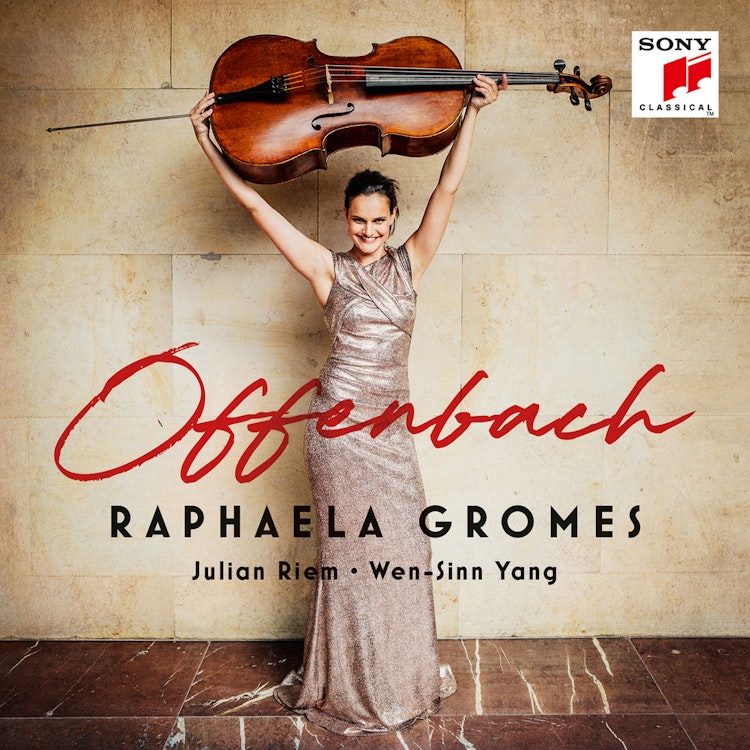
Cellist Raphaela Gromes marks Jacques Offenbach's 2019 bicentenary with an album of his music for cello. Though better known today as the composer of operettas and Les Contes d'Hoffmann, Offenbach was also a virtuoso performer known in his day as "the Liszt of the cello". His works for the instrument include a number of miniatures with piano accompaniment – pianist here is Julian Riem – as well as the Duo for Two Cellos, for which Gromes is joined by Wen-Sinn Yang. The three performers also play an arrangement of the famous Barcarolle together.
Featuring
Raphaela Gromes
Julian Riem
Wen-Sinn Yang
Jacques Offenbach
Did you know?
1/7
Compositional Technique
Offenbach's cello pieces were often 'functional works,' written to provide him a livelihood and advance his career, rather than for posterity.
Performer Biography
Raphaela Gromes, the cellist on this album, began studying the cello at age four using the first volume of Offenbach's 'Cours méthodique de duos'.
Historical Context
Salon music, like that by Offenbach, Chopin, and Liszt, was crucial in 19th-century capitals for social functions, supporting musicians, and introducing new musical trends.
Composer Biography
Offenbach's sister, Julia Grünewald, recounted that he taught himself to play the cello at age nine, surprising their father, Cantor Isaac Offenbach.
Recording & Production
This album includes a world-premiere recording of Offenbach's 'Tarentelle' and was created in close cooperation with the Offenbach Edition Keck (OEK).
Composer's Artistic Vision
Offenbach's cello works are described as enchanting, full of rhythmic subtleties and melodic beauties, exploiting the instrument's full range and cantabile qualities.
Composer Biography
Jacques Offenbach, later famous for operas like 'Orpheus in the Underworld,' first gained recognition as an exceptional cellist.
You might also enjoy...
Shostakovich: Complete Chamber Music for Piano and Strings
Saint-Saëns & Taneyev: Taste the Best
Martha Argerich - Chamber
Nielsen: Complete Chamber Works for Winds
Nielsen: Chamber Music, Vol. 1
R. Schumann & Brahms: Cello Works
Obrigado Brazil
Obrigado Brazil (Remastered)
B. Tchaikovsky: Piano Trio, Cello Sonata & Solo Cello Suite
Vasks, P.: Gramata Cellam / Partita / Episodi E Canto Perpetuo
Zoltán Kodály: Sonata for Cello Solo, Cello Sonata, Duo for Violin and Cello