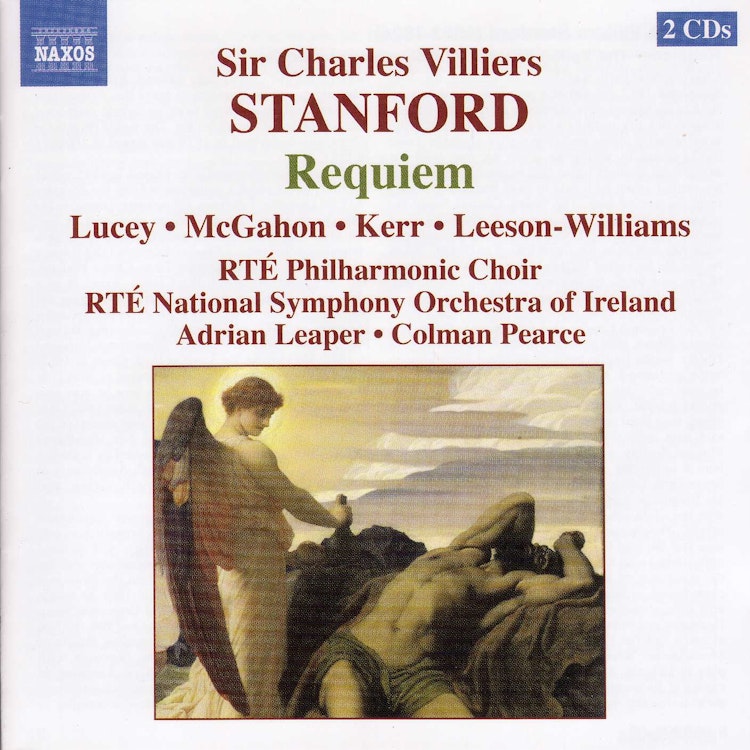
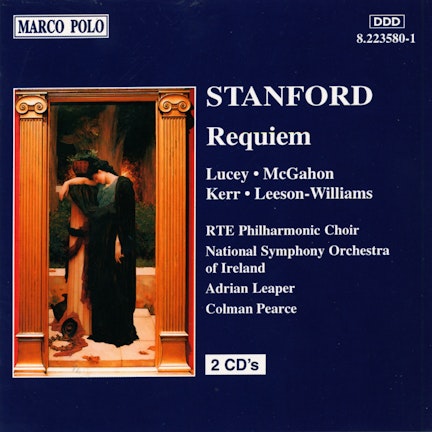
Stanford: Requiem / The Veiled Prophet of Khorassan
4/27/2005, 11 Tracks, 1:44:25
Featuring
Adrian Leaper
Mark Duley
Frances Lucey
Colette McGahon
Peter Kerr
Nigel Leeson-Williams
Colman Pearce
Virginia Kerr
RTÉ National Symphony Orchestra
RTÉ Philharmonic Choir
Charles Villiers Stanford
Did you know?
1/7
Recording & Production
The RTÉ National Symphony Orchestra of Ireland won a Critics' Award at the 2004 Cannes Classical Awards for its recording of Joly Braga Santos's Symphony No. 4.
Composition History
Stanford's Requiem Mass was composed in memory of the painter Lord Leighton, a significant figure in English culture who died in 1896.
Composer Biography
Despite being a towering figure in the English musical establishment, Charles Stanford remained deeply Irish, as reflected in works like his Irish Symphony and six Irish Rhapsodies.
Compositional Technique
Stanford's Requiem is a central work in his output, uniting his love of opera and song in its vocal ensembles with his skill as a symphonist through the economical use of thematic 'cells'.
Composer Biography
Charles Stanford, born in Dublin in 1852, began composing at the age of four and became a choral scholar at Cambridge University in 1870.
Compositional Technique
The scale of Stanford's Requiem is comparable to the great Requiems of Berlioz and Verdi, featuring extensive use of four soloists and Italianate vocal writing.
Composer's Artistic Vision
Stanford's Requiem, while on a Catholic text, aligned with the artistic ideals of Lord Leighton, both believing that 'Beauty is truth, truth beauty'.
You might also enjoy...
Stanford: Requiem / The Veiled Prophet of Khorassan
Stanford: Requiem / The Veiled Prophet of Khorassan
Paray: Symphony No. 1 & Joan of Arc Mass
Eimer Iseler Singers
Schoenberg, A.: Kol Nidre / Bernstein, L.: Halil / Bloch, E.: Baal Shem / Zeisl, E.: Requiem Ebraico (Remembrance)