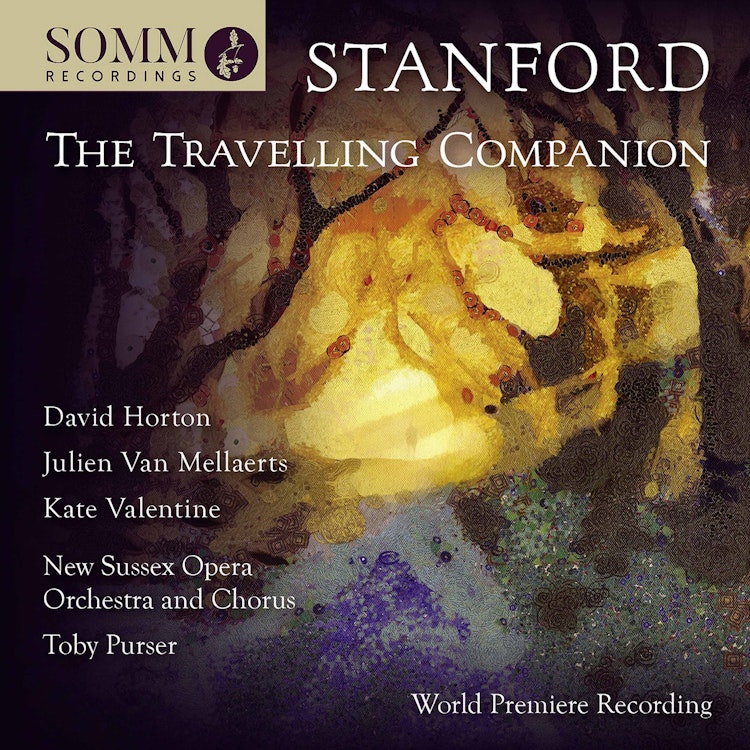
The idea for 'The Travelling Companion' came from Irish baritone Harry Plunket Greene, who suggested Hans Christian Andersen's tale as an opera subject to Stanford in 1911.
Recording & Production
This recording of 'The Travelling Companion' is a live recording from Saffron Hall, Saffron Walden, captured on December 2, 2018, and is noted as a "First Recording."
Critical Reception
When 'The Travelling Companion' received its first London performances in 1935, critics like William McNaught of 'The Musical Times' praised it as highly musical, questioning its long neglect.
Composition History
Charles Villiers Stanford's opera, 'The Travelling Companion', was his last operatic score, completed in 1916.
Notable Performances
Despite winning a Carnegie Trust Award in 1917, 'The Travelling Companion' was not fully performed until after Stanford's death in 1924, with its first hearing in Liverpool in 1925.
Compositional Technique
Stanford's 'The Travelling Companion' uses a homophonic 'death' motive from his 'Six Characteristic Pieces' for piano, which pervades the opera and is heard in the orchestral prelude.
Composition History
The libretto for 'The Travelling Companion' was written by Henry Newbolt, a poet whose work Stanford had previously set in his popular 'Songs of the Sea' and 'Songs of the Fleet'.
You might also enjoy...
Thomas: Hamlet
Puccini:Turandot
Rossini: Guillaume Tell
Rossini: Sigismondo
Pierne: Cydalise et le Chevre-Pied
Rossini: Eduardo e Cristina
Puccini: Manon Lescaut - The Sony Opera House
Massenet: Thaïs
Antonín Dvorák: Rusalka (Opera) [Highlights] [Sung in German] [Mitzewa]