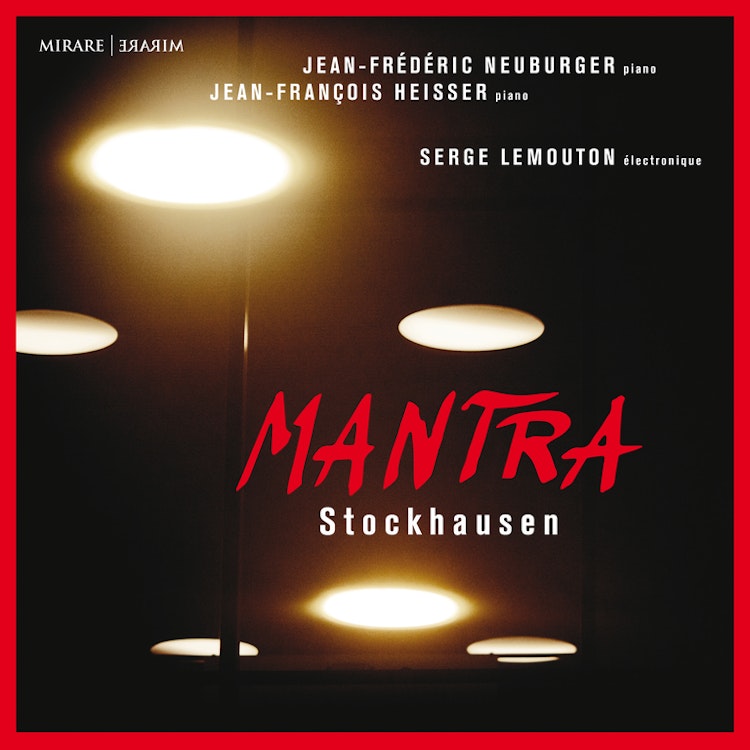
Stockhausen believed music originated from a single principle that unfolded in a macroscopic universe, and he linked this to the Indian mystical concept of a "mantra" as a repeated prayer.
Performer Biography
Jean-François Heisser, one of the pianists on this album, taught piano at the Conservatoire National Supérieur de Musique et de Danse in Paris, and Jean-Frédéric Neuburger, the other pianist, was one of his students.
Recording & Production
This recording of "Mantra" is the first by French musicians and was made to commemorate the 50th anniversary of its premiere in 1970.
Compositional Technique
The entire work of "Mantra" is derived from a single 13-note melodic formula, which is subjected to numerous transformations and extensions.
Historical Context
"Mantra" was created in 1970, against the backdrop of the Vietnam War, the protest movement, and a growing interest in Eastern philosophies.
Composition History
Karlheinz Stockhausen's "Mantra" marks the beginning of his final creative period, which he called "formula composition" (Formelkomposition).
Compositional Technique
The electronic transformations in "Mantra" can make the piano sounds resemble real bells or an Indonesian gamelan, with thirteen levels of gradation.
You might also enjoy...
György Ligeti – Études pour Piano
Górecki: Toccata for Two Pianos, Op. 2
The Charterhouse Suite - Six Short Pieces for Piano
Saint-Saëns: Carnival of the Animals, R. 125: XIII. The Swan (Arr. Naoumoff for Piano 4 Hands)
More Rivers
Cascioli: 12 Études
Deux valses pour deux pianos: I. Valse lente (arr. for Solo Piano)
Stockhausen: Mantra
Stevenson, R.: Passacaglia on DSCH
Borodin: Petite Suite
Braunfels: Variationen über ein altfranzösisches Lied für 2 Klaviere, Op. 46