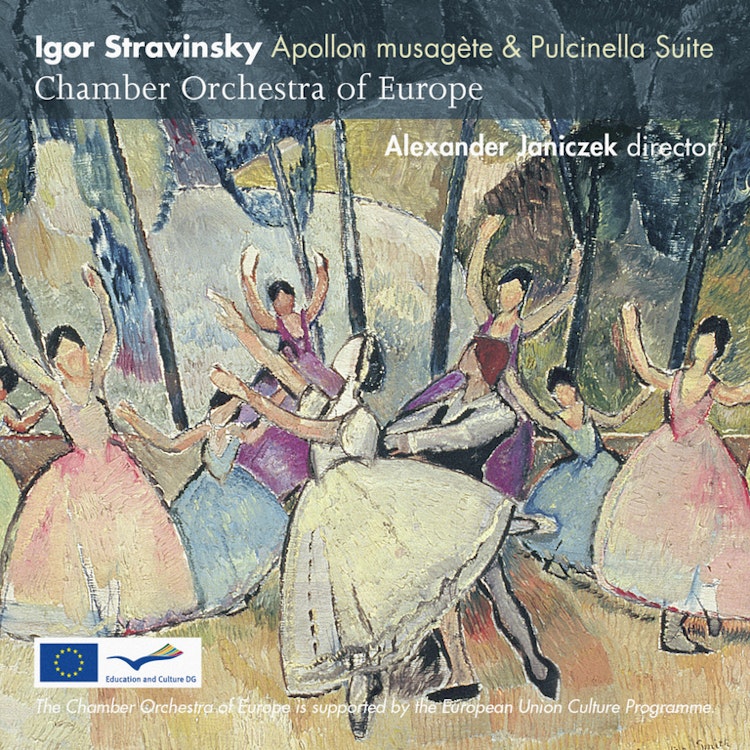
In Pulcinella, Stravinsky subtly annotated melodies and bass lines of earlier composers, sometimes adding modern touches like an unchanging drone or radically recomposing sections to create a rhythmically energized, distinctly Stravinskian sound.
Composition History
The initial idea for Stravinsky's Pulcinella came from Sergey Diaghilev, impresario of the Ballets Russes, who wanted arrangements of music by the 18th-century Italian composer Giovanni Battista Pergolesi.
Compositional Technique
For Apollon musagète, Stravinsky aimed for a 'ballet blanc' of purity and unity, scoring it for strings alone and using almost exclusive diatonic harmony to avoid violent contrasts.
Composer's Artistic Vision
Stravinsky considered Pulcinella a turning point, an 'epiphany' that made his later work possible and revealed the potential of engaging with earlier music to renew his own musical language.
Composer's Artistic Vision
Stravinsky viewed music history as his only true home, exploring various periods and styles, from ancient folklore to Baroque masters like Pergolesi, to find inspiration.
Composer Biography
Igor Stravinsky, though born in Russia, spent most of his life in exile, living in Switzerland, France, and America, and did not return to his homeland for almost half a century.
Performer Biography
The Chamber Orchestra of Europe (COE) was founded in 1981 by young musicians from the European Union Youth Orchestra who wanted to continue performing together at a high professional level.
You might also enjoy...
Stravinsky: Petrushka & Firebird Suite
Santtu Conducts Stravinsky
Strawinsky: Feuervogel/Pulcinella
Shchedrin: Carmen Suite / Concerto for Orchestra
Stravinsky: L'Oiseau de Feu (Suite); Le Sacre du Printemps
Bizet-Schedrin - Carmen Suite & Stravinsky - Firebird Suite
Stravinsky: Petrouchka; Divertimento from Le Baiser de la fée
Stravinsky: L'oiseau de feu / Le sacre de printemps
STRAVINSKY: Firebird (The) / The Rite of Spring
Stravinsky: Firebird Suite (The) / Petrushka
Stravinsky: Le sacre du printemps & The Firebird Suite
Stravinsky: The Rite of Spring & Dumbarton Oaks
Stravinsky: The Rite of Spring & The Firebird Suite