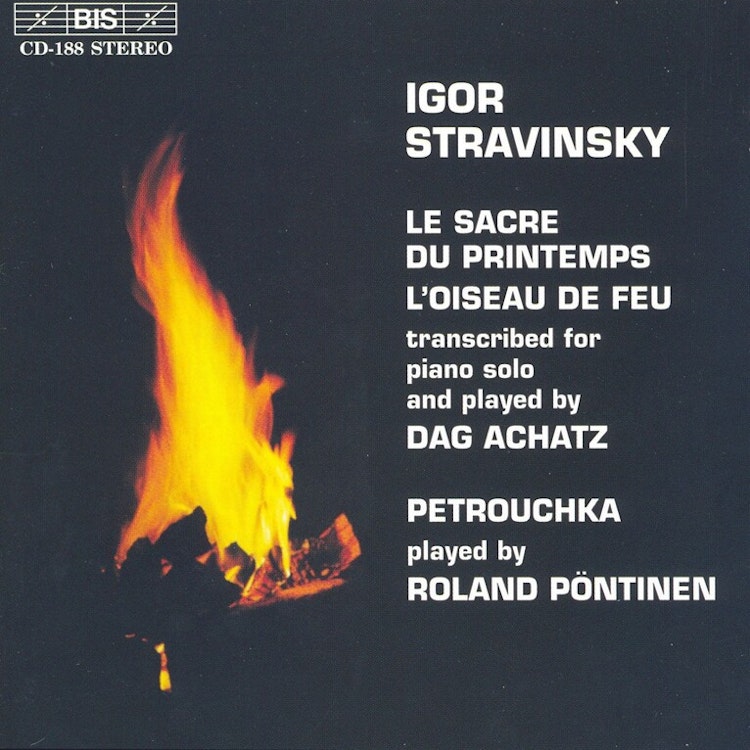
Stravinsky: Rite of Spring (The) / The Firebird Suite (Arr. for Piano)
1/31/1988, 10 Tracks, 1:11:48
Featuring
Dag Achatz
Roland Pöntinen
Igor Stravinsky
Did you know?
1/7
Cultural Impact
Stravinsky's "The Rite of Spring" had such an impact that Western orchestral music could no longer continue in the tradition of romanticizing classicism without appearing ridiculous.
Compositional Technique
A significant part of "The Rite of Spring's" shocking effect comes from its extravagant scoring, which includes five flutes, five clarinets, five bassoons, eight French horns, and a large percussion section.
Critical Reception
The premiere of Stravinsky's "The Rite of Spring" in Paris in 1913 caused one of the greatest scandals in musical history.
Composer's Artistic Vision
Stravinsky's "The Rite of Spring" is described as a creation myth that explores humanity's deepest ideas about life and its cycles.
Composition History
Igor Stravinsky's "The Rite of Spring" was originally conceived from visions of a heathen ritual to celebrate the return of spring.
Interpretation
Dag Achatz created his own piano work of "The Rite of Spring" based on Stravinsky's four-hand version and the orchestral score, aiming for astonishing virtuosity and rhythmic precision.
Performer Biography
Dag Achatz, the pianist on this album, was born in Stockholm in 1942 to two musician parents and received his diploma from the Geneva Conservatory with great distinction.
You might also enjoy...
Schubert: Impromptus, D. 899 - Baynov, Stoyanov & Vladigerov: Piano Works
Russian Piano School: Valery Kastelsky
Truth
Trinity
Clementi: Gradus ad Parnassum, Vol. 4 (Nos. 66-100)
Ground (Toccatas & Ambients)
Rossini: Prélude Prétentieux, Spécimen de Mon Temps, Valse Anti-Dansante, etc.