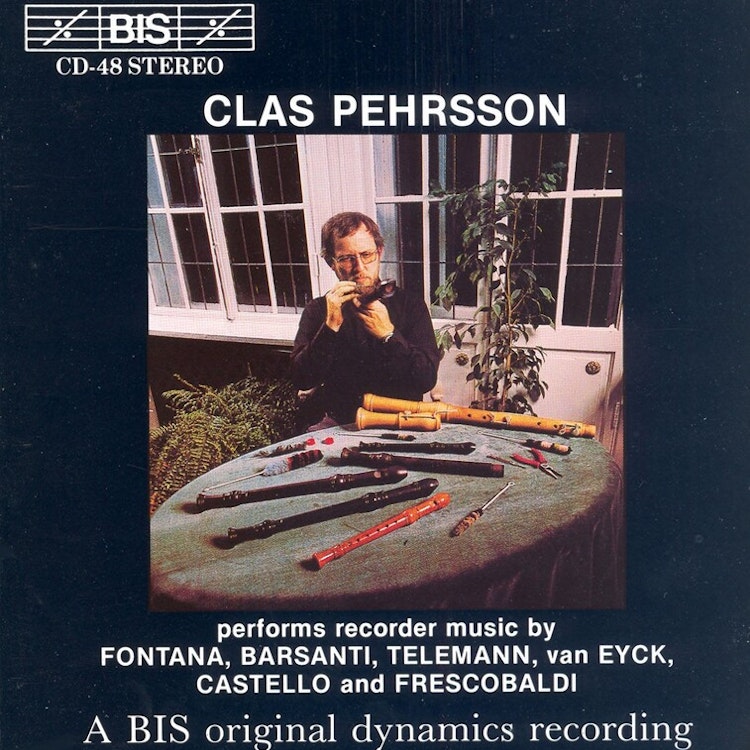
Telemann / Fontana / Castello: Recorder Chamber Music
2/28/1995, 19 Tracks, 57:37
Featuring
Clas Pehrsson
Bengt Ericson
Anders Öhrwall
Thomas Schuback
Maria Wieslander
Kari Ottesen
Tommie Andersson
Giovanni Battista Fontana
Francesco Barsanti
Georg Philipp Telemann
Jacob van Eyck
Dario Castello
Girolamo Frescobaldi
Did you know?
1/7
Composer Biography
Jacob van Eyck, a musician at a church in Utrecht, had a duty to entertain people walking in the churchyard by playing his recorder.
Performer Biography
Clas Pehrsson, the recorder player on this album, was active as a violinist and violist before dedicating most of his time to the recorder in the mid-1960s.
Recording & Production
For Girolamo Frescobaldi's Toccata, the continuo part was transferred to the organ to emphasize the harpsichord's role as a solo instrument, allowing the recorder to perform with two keyboard instruments simultaneously.
Historical Context
The recorder virtually disappeared from classical music towards the end of the 18th century, eclipsed by the transverse flute, and only reappeared in the early 20th century due to renewed interest in early music.
Composer's Artistic Vision
Georg Philipp Telemann wrote his 12 methodic sonatas with a pedagogical intent, aiming to show how slow movements should be 'improved' through improvisation.
Compositional Technique
Giovanni Battista Fontana's Sonata prima, representing early 17th-century Venetian music, is played without breaks, unlike later High Baroque works with clearly defined movements.
Composer Biography
Francesco Barsanti, composer of the Sonata in C minor, moved to England after studying law in his native Italy and published a large quantity of music there.
You might also enjoy...
The Virtuoso Recorder, Vol. 3
Italian Baroque: The Instrumental Edition, Vol. 1
Officina Romana: A Wonder Lab at the Dawn of the 18th Century
Potsdam Meets Vienna
Total Eclipse: Music for Handel's Tenor
Pastorale
London circa 1740: Handel's musicians
J. S. Bach: Werke für Violine und Cembalo Vol. 4
Te Deum - Festliche Musik am Hof von Versailles (Inspiration)
Johann Rosenmüller: Dixit Dominus · Sacred Concertos