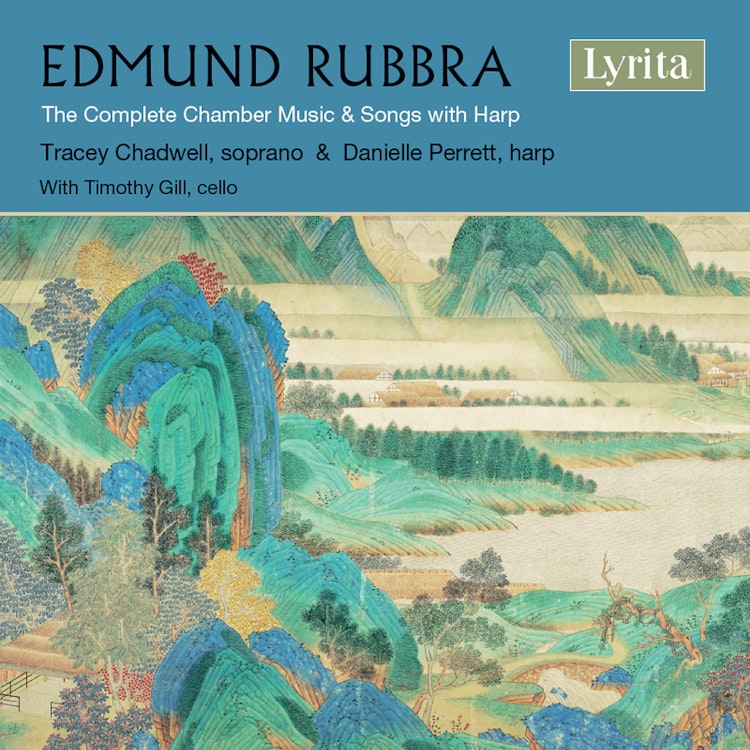
Rubbra became a Roman Catholic in 1948, and Christianity remained central to his worldview, as seen in early works like 'Rosa Mundi' and 'The Mystery'.
Composer's Artistic Vision
Edmund Rubbra's music, characterized by its meditative qualities, reflects his roots in Western Christianity and a lifelong interest in Eastern thought and music.
Compositional Technique
Rubbra's 'Pezzo Ostinato' for harp is based entirely on a four-note ascending pattern, creating a meditative effect that sounds contemporary despite being written in 1958.
Composition History
Rubbra's arrangement of 'Japanese dance (Deep River)' may have been written for the Arts League of Service, a group of travelling players, for a 1929 Noh play, or for the dancer Algeranoff.
Composition History
Rubbra's 'Pezzo Ostinato' for solo harp was inspired by hearing the Indian musician Ali Akbar Khan perform in London and is dedicated to ethnomusicologist Peter Crossley-Holland.
Composition History
Rubbra's song cycle, 'Songs with Harp', setting T'ang Dynasty poems, was written for soprano Elizabeth Robinson and harpist Ann Griffiths, who premiered it on BBC radio in 1963.
Composition History
Herbert Howells' 'Prelude (No.1)' for harp, written in 1915, was never published and only came to light after the death of its dedicatee, Kate Wilson, in the 1970s.
You might also enjoy...
Crossing the Ocean
Godelieve Schrama: Masterworks from the Harp Repetoire
Autumn
Revelation
Don Quixote Dreams
Tchaikovsky: The Seasons
Liszt: 3 Liebesträume, S. 541 (Arr. for Harp by Nora von Marschall)
Gourzi - Wind in April
Ravel: Pavane pour une infante défunte
Pachelbel: Canon in D Major, P. 37/1 (Arr. Coates & Lawson for Harp)