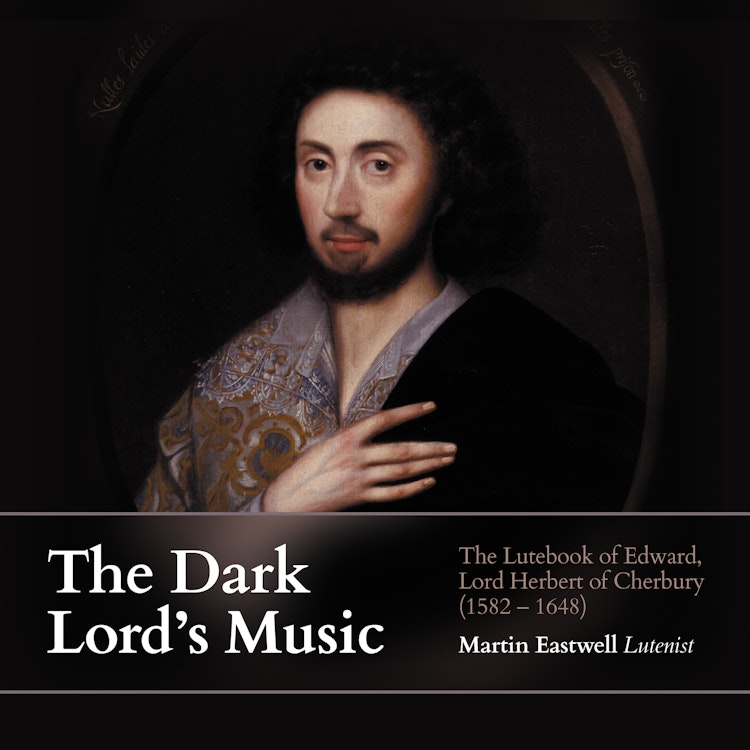
The Dark Lord's Music: The Lutebook of Edward, Lord Herbert of Cherbury
6/1/2018, 20 Tracks, 1:17:39
Featuring
Martin Eastwell
Jakub Polak
Du Gast
Robert Johnson
John Dowland
Daniel Bacheler
Diomedes Cato
Jacques Gaultier
Henri de L'Enclos
Cuthbert Hely
Luc Despond
Edward Herbert
Did you know?
1/7
Composition History
Lord Herbert's lute book, preserved in the Fitzwilliam Museum, is a crucial source of English and Continental instrumental music from the 17th century.
Historical Context
Lord Herbert's major philosophical work, 'De Veritate...', was on the Catholic Church's 'Index of Forbidden Books' until 1966, earning him the title 'Father of English Deism'.
Recording & Production
This recording features two different 10-course lutes: one after Hans Frei made in 2005, and another after Sixtus Rauwolf made in 2016.
Composer Biography
Edward, Lord Herbert of Cherbury, was a prominent 17th-century English figure, known as a diplomat, soldier, courtier, philosopher, poet, historian, musician, and autobiographer.
Album & Artwork
The album title, 'The Dark Lord's Music', refers to Edward, Lord Herbert of Cherbury, who was known as 'The Dark Lord Herbert' by his contemporaries.
Instruments
During Lord Herbert's lifetime, lutes underwent significant changes, including lengthened and widened necks to accommodate extra pairs of strings, known as 'courses'.
Composer's Artistic Vision
Lord Herbert of Cherbury learned music to entertain himself at home and refresh his mind after studies, avoiding the 'ill example and deboist' company of young men.
You might also enjoy...
Lord Herbert of Cherbury's Lute Book
Lute Music, Volume 2: Early Italian Renaissance Music
Hasse, J.A.: Opera Arias Transcribed for Lute
HAGEN: Lute Sonatas / Locatelli Variations
Giacomo Gorzanis: Solo Lute Music
Giacomo Gorzanis: Solo Lute Music
Da Milano: Music for Lute
Amours amours amours
Luca Marenzio e il suo tempo
Lyra Sonora: Music for the 12 Course Lute
The Royal Lewters - Music of Henry VIII and Elizabeth I's Favourite Lutenists
From Heaven on Earth - Lute Music from Kremsmunster Abbey
Joachim Van den Hove: Florida, Pavanas, Fantasias and Dances for Lute
Lute Recital: Timofeyev, Oleg - Kapsberger, G.G. / Melli, P.P. / Bernia, V. / Galilei, M. / Ballard, R. / Grotte, N. / Vallet, N. / Timofeyev, O.