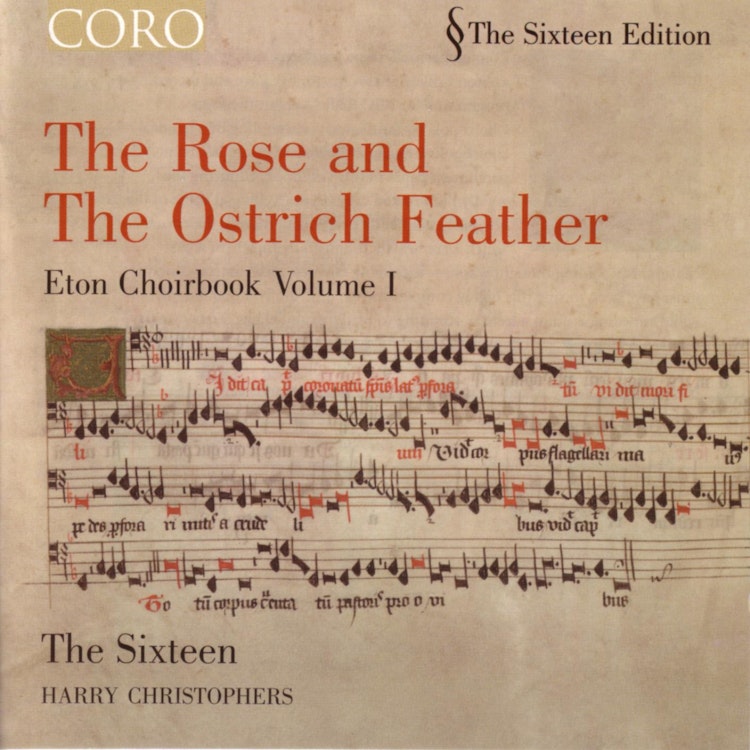
The Rose and The Ostrich Feather: Eton Choirbook Volume I
5/17/2005, 6 Tracks, 1:02:32
Featuring
Harry Christophers
Neil MacKenzie
Philip Newton
Simon Berridge
Christopher Purves
Francis Steele
Tim Jones
Carys Lane
The Sixteen
Robert Fayrfax
Richard Hygons
Edmund Turges
John Browne
Anonymous
William Cornysh
Did you know?
1/7
Historical Context
Tudor church music suffered immense losses due to political and theological changes during the Reformation, with countless works destroyed or rendered obsolete.
Composition History
Most of the music in the Eton Choirbook was not composed specifically for Eton College, but was drawn from the repertoires of other choirs and copied by an unknown editor in London.
Historical Context
The Eton Choirbook is the largest and most valuable document of early Tudor church music still in existence, without which the music of its age would be largely unknown.
Recording & Production
This album was recorded at St. Bartholomew's Church, Orford, Suffolk, and was originally released on the Collins label.
Compositional Technique
John Browne's antiphon 'Stabat iuxta Christi crucem' quotes extensively from a partsong by London composer Edmund Turges, making it an allegory on the untimely death of Prince Arthur in 1502.
Album & Artwork
The Eton Choirbook series, from which this album is Volume I, is an award-winning collection of CDs by The Sixteen.
Composer's Artistic Vision
The album's title, 'The Rose and The Ostrich Feather', refers to emblems of Elizabeth of York (the lily-white rose) and Prince Arthur (the ostrich feather), which merge into the veneration of Christ and his Mother.
You might also enjoy...
Tye: Missa Euge bone & Western Wynde Mass
Thomas Tomkins: Cathedral Music
Music for Holy Week
Refuge from the Flames, Miserere and the Savonarola Legacy
The Splendour of Florence with a Burgundian Resonance
Palestrina, Vol. 4
Love Divine: Renaissance & Contemporary Choral Works