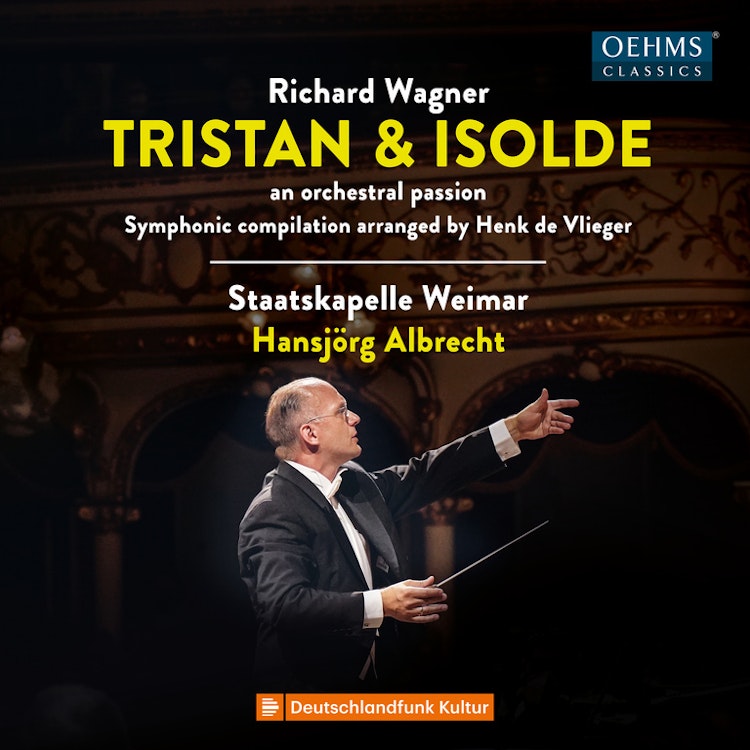
Hansjörg Albrecht, the conductor on this album, is one of the few artists who regularly performs internationally as both a conductor and a concert organist.
Notable Performances
The premiere of "Tristan und Isolde" in Munich in 1865 was delayed and the lead tenor, Ludwig Schnorr von Carolsfeld, died at 29 after only three performances, fueling a myth about the work's difficulty.
Interpretation
Henk de Vlieger, a composer, arranger, and percussionist, created this "Orchestral Passion" in 1994, reducing Wagner's "Tristan und Isolde" to a continuous hour of instrumental music.
Compositional Technique
Richard Wagner's "Tristan und Isolde" is considered the beginning of musical Modernism, largely due to its harmony, epitomized by the famous 'Tristan chord' that opens the opera.
Composition History
Wagner initially intended "Tristan und Isolde" to be a quick, easily performable work in Italian for the Emperor of Brazil, to be composed during a lull in his work on the "Ring" cycle.
Historical Context
The Staatskapelle Weimar, the orchestra on this recording, was founded in 1491 and is one of the oldest and most traditional orchestras in the world, associated with figures like Bach, Liszt, and Richard Strauss.
Composer's Artistic Vision
Richard Wagner wrote to Mathilde Wesendonk, his muse for "Tristan und Isolde," that he feared the opera would be banned if performed well, as it would drive people mad.
You might also enjoy...
Dangerous Journeys
Grime: Woven Space
Wolfgang Rihm: Jagden und Formen (Zustand 2008) [Live]
Lentz: Guyuhmgan - Monh - Ngangkar
Schat: De Hemel - The Heavens
Ge Gan-Ru: Chinese Rhapsody
Chin: Rocaná
Petitgirard: Si Yeou Ki
Wagner: The Ring – An Orchestral Adventure
Five Scenes For Orchestra: Scene 1, Misterioso
Maw: Odyssey (Live)
Song of Thirteen Moons
Eduardo Reck Miranda: Mind Pieces, Sound to Sea. Computer-Aided Symphonic Works