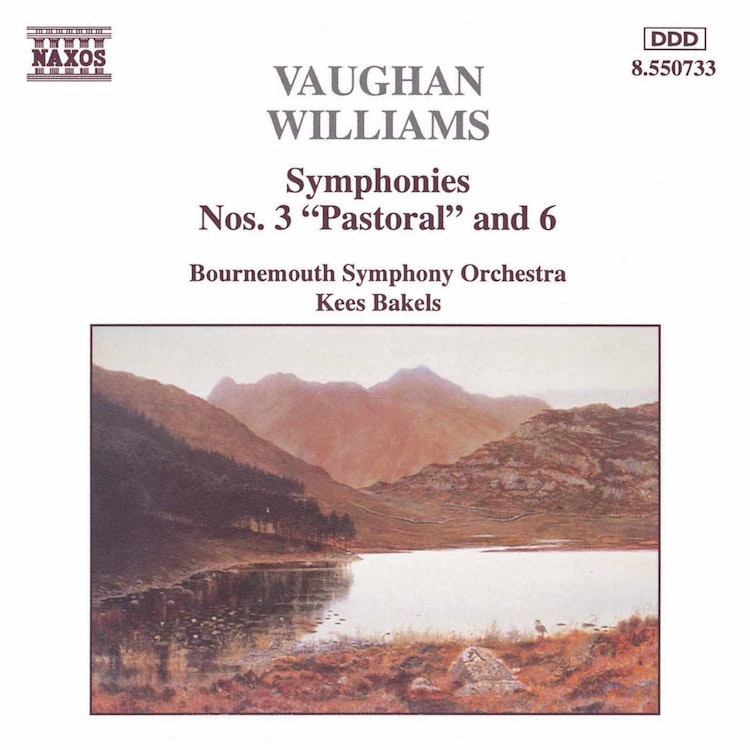
Vaughan Williams: Symphonies Nos. 3, 'Pastoral', and 6
12/17/1994, 8 Tracks, 1:11:17
Featuring
Kees Bakels
Patricia Rozario
Brendan O'Brien
Bournemouth Symphony Orchestra
Ralph Vaughan Williams
Did you know?
1/7
Composer's Artistic Vision
Vaughan Williams actively collected folk music from various regions of England, an interest that significantly shaped his musical language.
Critical Reception
One hostile critic satirized Vaughan Williams's Pastoral Symphony as 'a cow looking over a gate,' despite its subtle and original conception.
Composition History
Vaughan Williams began writing his Third Symphony, the Pastoral Symphony, in Northern France in 1916 while serving in the Royal Army Medical Corps during World War I.
Composer Biography
Ralph Vaughan Williams's maternal grandfather was a Wedgwood, and his grandmother was a Darwin, indicating a distinguished intellectual ancestry.
Composer Biography
Vaughan Williams studied with prominent figures like Hubert Parry and Charles Villiers Stanford at the Royal College of Music, and later with Max Bruch in Berlin and Maurice Ravel in Paris.
Compositional Technique
The Pastoral Symphony includes a vocalise for soprano or tenor in its last movement, though a clarinet can be used as an alternative.
Critical Reception
Vaughan Williams rejected the interpretation of his Sixth Symphony as a 'War Symphony,' instead relating its last movement to Prospero's farewell from Shakespeare's 'The Tempest.'
You might also enjoy...
Vaughan Williams: Symphonies Nos. 5 & 9
Vaughan Williams: Symphonies Nos.4 & 6
Vaughan Williams: Symphonies Nos 5 & 6
Vaughan Williams: Symphony No. 2 'A London Symphony' & Symphony No. 8 in D Minor