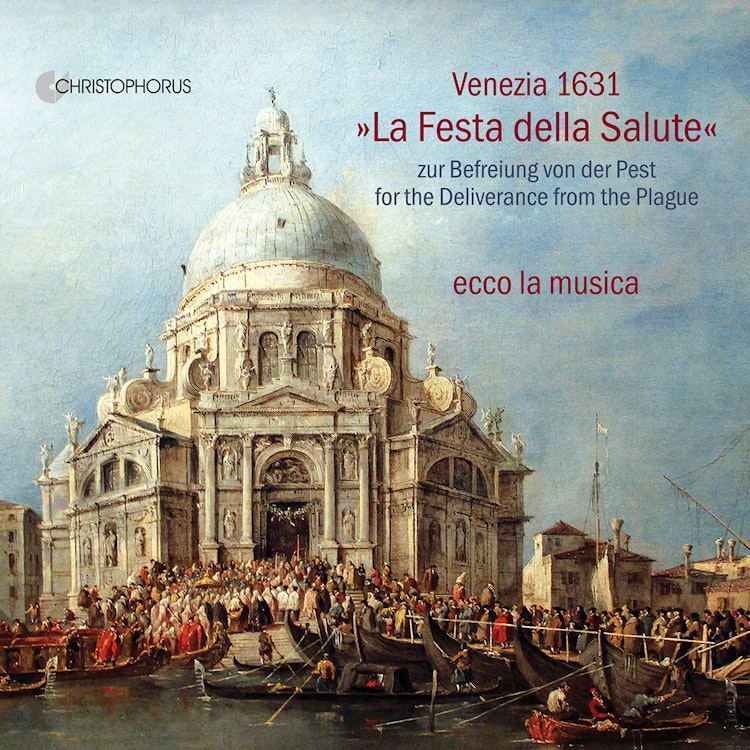
The Santa Maria della Salute, a prominent church in Venice, was vowed by Doge Nicolò Cantarini in 1630 to be built if the city was freed from the plague, but was only consecrated over fifty years later in 1687 due to high costs.
Recording & Production
The ensemble ecco la musica, founded by Baroque trombonist Matthias Sprinz and co-led with Heike Hümmer, specializes in Venetian music of the seicento and aims to rediscover and perform forgotten musical treasures.
Composition History
The Festa della Salute, a thanksgiving festival to the Virgin Mary for deliverance from the plague, was first celebrated on November 21, 1631, and has been held annually ever since.
Instruments
The recording features period instruments including a violin by Michael Pilger after A. Amati 1574, a cornetto by Serge Delmas after 17th-century Venetian models, and a chitarrone by Marcello Armand-Pilon after M. Tieffenbrucker ca. 1600.
Historical Context
The plague epidemic of 1630/31 marked a turning point for Venetian music, as many musicians died, leading to a decline in wind ensembles and cornett virtuosity, and a rise in the importance of string instruments.
Historical Context
The album's title, "Venezia 1631 'La Festa della Salute'", refers to the end of Venice's last major plague outbreak in 1630/31, which killed over a third of the city's population.
Composer Biography
Claudio Monteverdi, a prominent Venetian composer, survived the plague but lost his son Francesco, a tenor at St Mark's, to the disease, leading Monteverdi to become ordained as a priest in 1632.
You might also enjoy...
Balli, battaglie e canzoni: 16th Century Music for Organ and Percussion
Music for Airports: Live
Corrette : Noël 1788 (Messes pour le temps de Noël - Nouveau Livre de Noëls)
J.S. Bach: Sonatas & Partitas
Michel de La Barre: Suites et sonates
Ritual Pictures
Prism
Pierre Colin, Trésor oublié de la Renaissance
Corno Di Caccia Recital: Tunnell, Michael – Knechtel, J.G. / Rollig, J.G. / Forster, C. / Graun, J.G. / Vivaldi, A. / Telemann, G.P. / Molter, J.M.