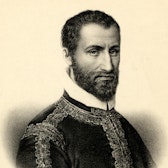
Victoria: Missa De Beata Maria Virgine & Missa Surge propera
11/24/2023, 12 Tracks, 1:07:56
Featuring
Alexander Hopkins
Martin Baker
Nicholas Keay
William Gaunt
Westminster Cathedral Choir
Tomás Luis de Victoria
Giovanni Pierluigi da Palestrina
Did you know?
1/7
Composer's Artistic Vision
Palestrina, despite primarily composing sacred music, wrote several books of secular and spiritual madrigals, and dedicated his fourth book of motets entirely to settings of poetry from the Song of Songs.
Compositional Technique
Victoria's Missa De Beata Maria Virgine is a paraphrase Mass based on a 12th-century Gregorian plainchant Mass and Credo I, making extensive use of melodic material from the plainchant.
Composer Biography
Tomás Luis de Victoria, the greatest composer of Spain's 16th-century 'golden age' of polyphonic music, spent twenty years in Rome, where he succeeded Palestrina as maestro di cappella in 1571.
Composer's Artistic Vision
Victoria's musical output was relatively small compared to other major Renaissance composers like Palestrina and Lassus, but he adopted a highly critical attitude to what he wrote, constantly revising his works.
Compositional Technique
Victoria's Missa Surge propera is a parody Mass, based on a motet of the same title by Palestrina, which uses text from the Song of Songs.
Composer Biography
Giovanni Pierluigi da Palestrina, a prominent Renaissance composer, was dismissed from the Pope's official chapel in 1555 because he was married, as the new Pope insisted on celibacy for its members.
Compositional Technique
Victoria's music, while sharing Palestrina's liking for smooth melodic lines, uses more accidentals and subtle harmonic coloration, giving it a passionate intensity.
You might also enjoy...
Masterpieces of Mexican Polyphony
Requiem: Masses by Capuana & Rubino
Samuel Lampel: Abendgebet Für Schabbat (Evening Prayer for Shabbat)
Spohr: Des Heilands letzte Stunden, WoO 62: Und wenn sie alle weichen, ich hange fest an dir
Maklakiewicz, J.: Swietokrzyska Mass / Missa tertia in honorem sancti Francisci Confessoris / Polish Mass
Todd, W.: Passion Music - Jazz Missa Brevis
Psalms
William Montillet: Messe Sainte Cécile - Quatre Motets - Messe "Tu es Pastor"
Moniuszko: Masses
The World of Favourite Hymns
Todd: Mass in Blue / Christus Est Stella / The Christ-Child / Ave Verum Corpus / None Other Lamb