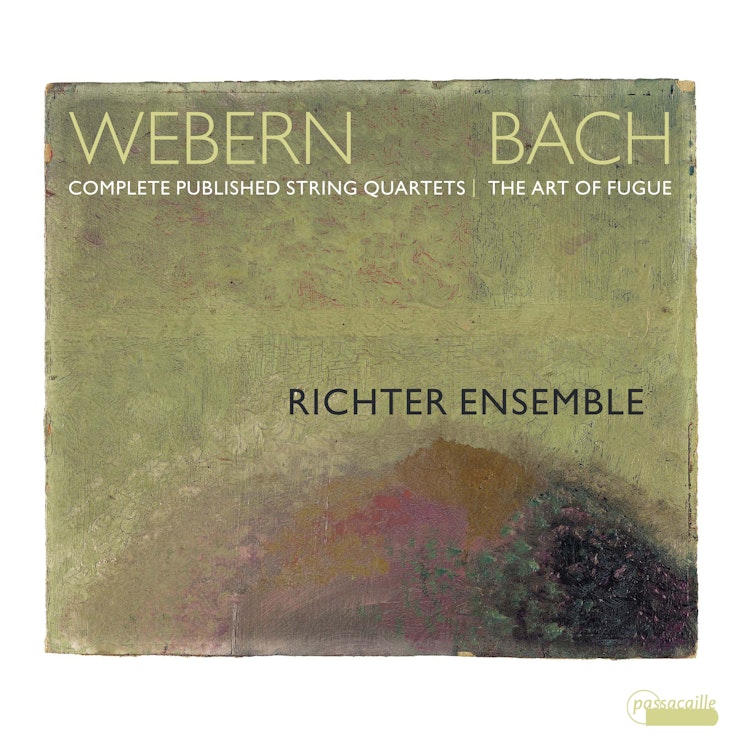
Webern: Complete Published String Quartets - Bach: The Art of Fugue
2/17/2023, 30 Tracks, 1:17:33
Featuring
Rodolfo Richter
Rebecca Huber
David Wish
Jennifer Morsches
Paolo Zuccheri
James Johnstone
Richter Ensemble
Johann Sebastian Bach
Anton Webern
Did you know?
1/7
Compositional Technique
The final fugue of Bach's The Art of Fugue, Contrapunctus XIV, includes the notes of Bach's name (B, A, C, H) as one of its three subjects.
Composition History
Bach's The Art of Fugue was composed and assembled in two separate periods, from the mid-1740s to around 1748, and then between 1748 and 1750.
Composer's Artistic Vision
Anton Webern, a 20th-century Austrian composer, revered Bach, stating that "You find everything in Bach: the development of cyclic forms, the conquest of the realm of tonality - the attempt at a summation of the highest order."
Album & Artwork
This recording juxtaposes Johann Sebastian Bach's The Art of Fugue with the complete string-quartet works of Anton Webern published in his lifetime.
Composer Biography
Anton Webern, a keen cellist, declared in 1910 that "Quartet playing is the most glorious music-making there is," reflecting his passion for string quartets.
Interpretation
The Art of Fugue was almost certainly conceived for personal contemplation and was not intended for concert performance, allowing musicians freedom in choosing movements and their order.
Composition History
Anton Webern's Five Movements for String Quartet, Op. 5, written in a freely atonal style, was dedicated to the memory of his mother and is an outpouring of grief.
You might also enjoy...
The Spirit of Love: Chamber Music by Ailsa Dixon
Giacinto Scelsi Collection, Vol. 5
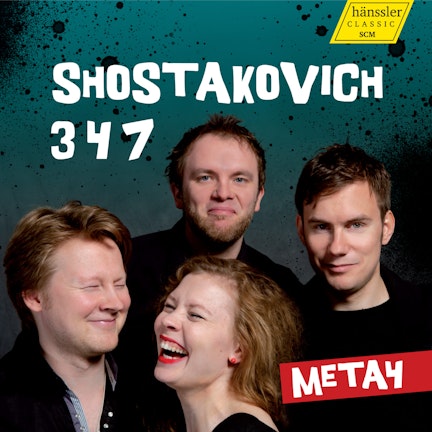
Shostakovich: String Quartets Nos. 3, 4 & 7
Nono: Fragmente - Stille, An Diotima For String Quartet
Byrd: Sing Joyfully (Arr. Pierini for String Quartet)
Ostendorf: String Quartet
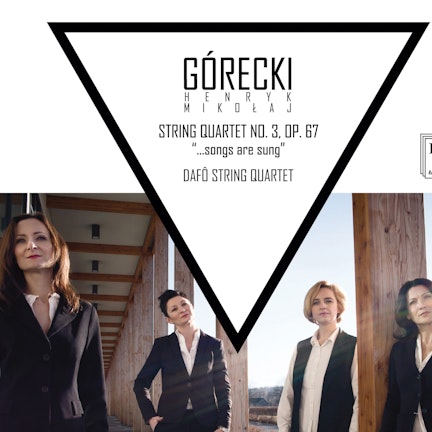
Gorecki: String Quartet No. 3, Op. 67 "...Songs Are Sung"
Henryk Gorecki: String Quartet No. 3 (...Songs Are Sung)