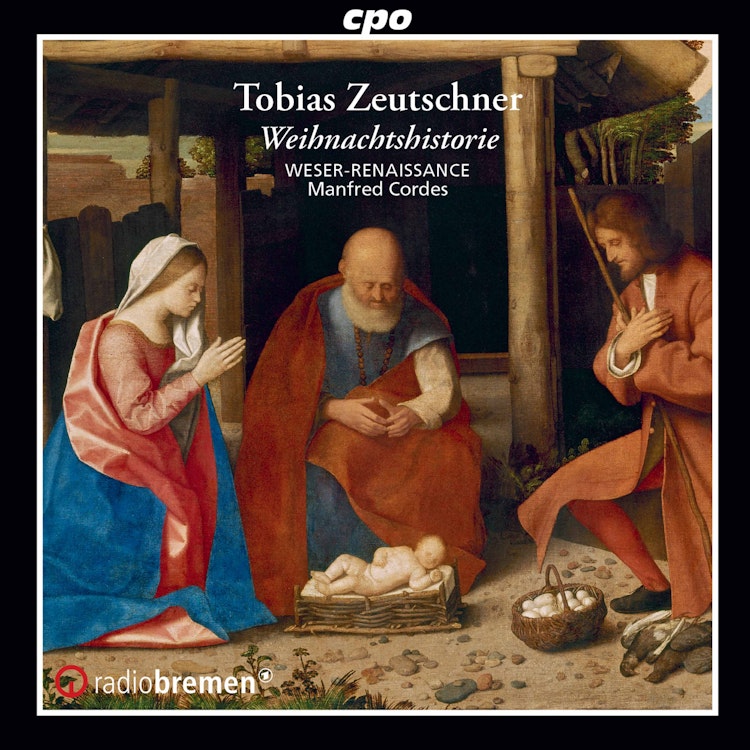
Tobias Zeutschner served as organist at St. Mary Magdalene church in Breslau from 1655 until his death in 1675, a church that was a major center for Lutheran religious and cultural life.
Historical Context
Zeutschner's family experienced confessional tensions in the region, as Lutheranism was forbidden in Grafschaft Glatz in 1622, forcing those who did not convert to Catholicism to leave town.
Performer Biography
Weser-Renaissance Bremen is an internationally renowned ensemble specializing in 16th and 17th-century music, focusing on repertoire from Josquin Desprez to Dieterich Buxtehude.
Recording & Production
The anonymous Magnificat cum rotulis was identified by soprano Marie Luise Werneburg, who recognized its Breslau adaptation while singing a Magnificat by Tarquinio Merula.
Compositional Technique
The St. Mary Magdalene church in Breslau was an ideal place for large-scale vocal-instrumental pieces due to its spacious Gothic architecture, which allowed for spatial arrangement of multiple performer groups.
Composition History
Most of Tobias Zeutschner's surviving compositions, over three-quarters, date from his time as organist at St. Mary Magdalene church.
Composer Biography
Tobias Zeutschner, a Silesian composer between Schütz and Bach, was an organist and poet who lived from 1621 to 1675.
You might also enjoy...
Charpentier & Desmarest: Te Deum
MARTINI: PRO DEFUNCTIS Psalms and Mass
Durante, Astorga, Pergolesi / Sacred Works
DHM Splendeurs: Durante, Astorga, Pergolesi / Sacred Works
Durante, Astorga, Pergolesi - Sacred Works
DHM Splendeurs: Durante, Astorga, Pergolesi / Sacred Works
Hasse: Misere Salve Regina Te Deum
Weckmann: Wie liegt die Stadt so wüste
Magnificat - Christmas in Leipzig
Bach, JS/Bach, CPE: Magnificats/Scarlatti: Messa di Santa Cecilia