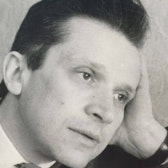
Weinberg considered himself a pupil of Dmitri Shostakovich, acknowledging his inspiration and stating, 'I count myself as his pupil, his flesh and blood.'
Composer Biography
Mieczysław Weinberg, the composer of these sonatas, fled the German occupation in 1939, first to Minsk and then to Tashkent, before settling in Moscow in 1943.
Critical Reception
Despite his current popularity, Weinberg's music was largely forgotten towards the end of his life, with his 75th anniversary going unnoticed and his scores no longer purchased by the Ministry of Culture.
Composition History
Weinberg composed four solo sonatas for viola between 1971 and 1983, dedicating them to prominent Soviet string players of his time.
Historical Context
Weinberg was imprisoned in February 1953 during Stalin's anti-semitic purges, but was released in April after Dmitri Shostakovich intervened with Lavrenty Beria, head of the KGB.
Performer Biography
Viacheslav Dinerchtein, the violist on this recording, is also an award-winning travel photographer, a FIDE-certified chess trainer, and a semiprofessional card magician.
Composition History
The genre of the solo sonata was one Weinberg mastered independently of his mentor, Dmitri Shostakovich, with the initial impulse coming from cellist Mstislav Rostropovich.
You might also enjoy...
Solo
Solo
Viola virtuosa
J.S. Bach: Cello Suite No. 2 in D Minor, BWV 1008 (Arr. for Viola by Marc Sabbah)
Telemann: Fantasies for viola solo
Viola Fantasies
Peter Vukmirovic Stevens: Feral Icons
Kleines Konzert Für Die Bratsche Allein
Druzhinin, Weinberg, Vieuxtemps & Bacewicz: Viola Works
Aperghis - Grisey - Sciarrino - Zimmermann: Works for Viola Solo
Weinberg: Complete Sonatas for Viola Solo - Sonata, Op. 28 - Druzhinin: Sonata for Viola Solo