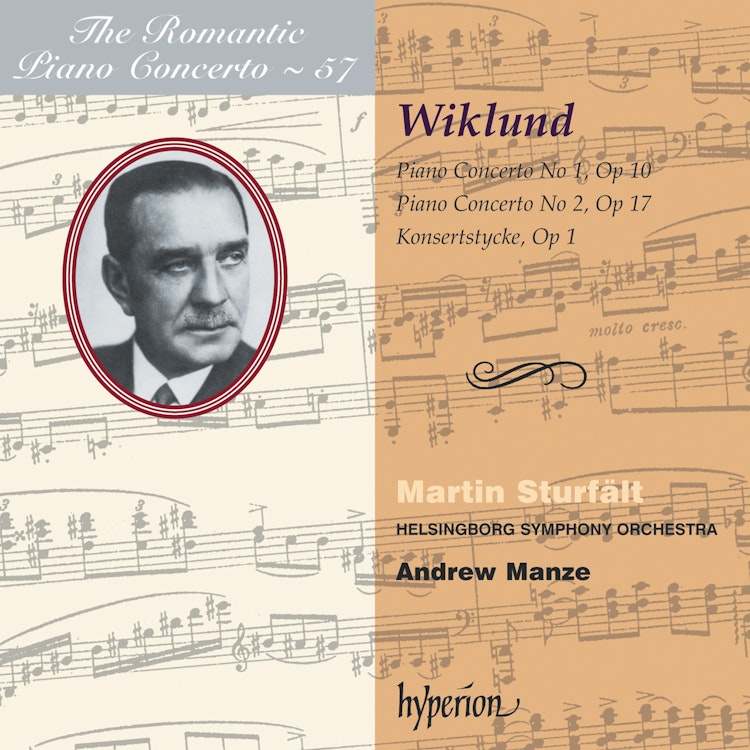
Wiklund: Piano Concertos Nos. 1 & 2 (Hyperion Romantic Piano Concerto 57)
2/16/2024, 7 Tracks, 1:14:58
Featuring
Martin Sturfält
Andrew Manze
Helsingborgs Symfoniorkester
Adolf Wiklund
Did you know?
1/7
Composition History
Adolf Wiklund's Konsertstycke Op 1 marked his official debut as both pianist and composer, performed by the Konsertföreningen (present-day Royal Stockholm Philharmonic) in 1902.
Composer's Artistic Vision
Adolf Wiklund's Piano Concerto No 1 in E minor, Op 10, is considered the first of his mature works, where he developed a personal, eclectic style within the late Romantic idiom, influenced by Germanic, Slavic, and Impressionistic sounds.
Interpretation
This recording primarily follows the original versions of Adolf Wiklund's concertos for the solo piano parts, while respecting cuts made in Op 10, due to issues with later revised scores containing errors.
Performer Biography
Martin Sturfält, the pianist on this album, has performed extensively across Scandinavia, the UK, Europe, Asia, and the USA, appearing with orchestras like the Hallé Orchestra and all Swedish orchestras.
Composer Biography
Adolf Wiklund, the composer, began playing piano and composing at age twelve, encouraged by his older brother Victor, despite his organist father initially wanting him to study engineering.
Critical Reception
Adolf Wiklund's Konsertstycke Op 1 was met with unanimous enthusiasm by critics in all four Stockholm newspapers, praised for its 'inventive ideas, admirable realization [and] commendable orchestration'.
Compositional Technique
The main theme of the finale of Adolf Wiklund's Piano Concerto No 1 has a curious origin: it is based on a two-note whistling pattern used by the Wiklund family to locate each other in a crowd.
You might also enjoy...
Zarzycki & Żeleński: Piano Concertos (Hyperion Romantic Piano Concerto 59)
Paisiello, G.: Piano Concertos Nos. 1, 3 and 5
Babadzhanian: Heroic Ballade; Nocturne / Tjeknavorian: Piano Concerto