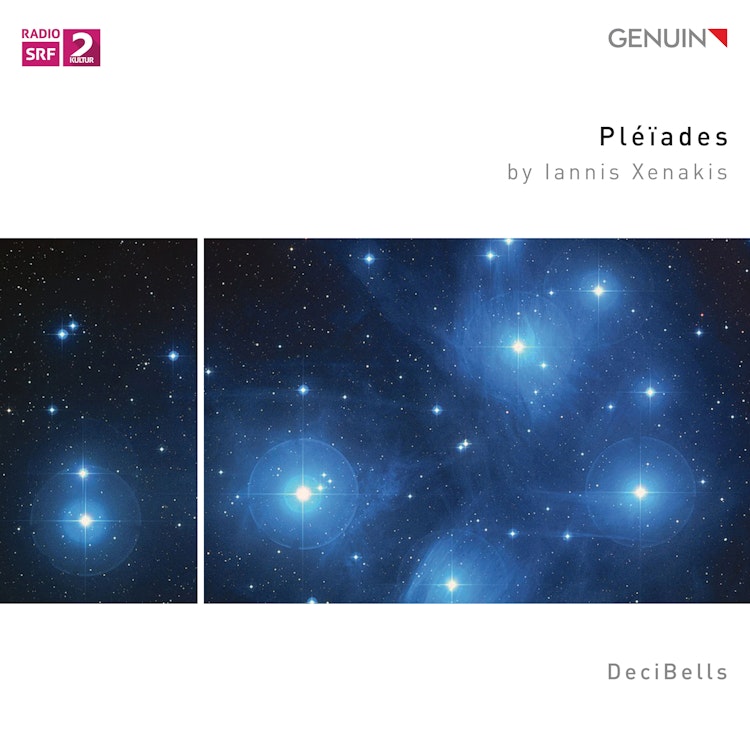
For "Pléïades," Xenakis designed six special metal instruments called 'sixxen,' a name he created by combining 'six' and 'Xenakis,' each having 19 metal bars with non-chromatic or diatonic tuning.
Recording & Production
For this recording, the company LUNASON developed new 'sixxen' instruments for the DeciBells ensemble, which sound more bell-like, softer, and have a richer overtone spectrum compared to the original instruments.
Compositional Technique
Iannis Xenakis's work "Pléïades" for six percussionists, composed in 1978/79, is a 45-minute composition that aims to create a hypnotic spell where individual sounds combine into overarching forms.
Recording & Production
This recording notably uses drums with natural heads, made by 'Vize Native Drums,' which provide a softer, punchier, and more massive, earthy drum sound compared to the plastic heads typically used.
Composer Biography
Xenakis's composition "Metastaseis," which brought him international recognition in New Music, utilized hyperbolic curves, a design element he also used for the Philips Pavilion at the Brussels World Exposition.
Composer's Artistic Vision
The piece "Pléïades" is based on the Pleiades, a star cluster in the Milky Way, and explores the musical transition where isolated events blend into a unified whole in human perception.
Composer Biography
Iannis Xenakis, a 20th-century composer, was originally trained as a civil engineer and worked as an assistant to architect Le Corbusier for 12 years in Paris.