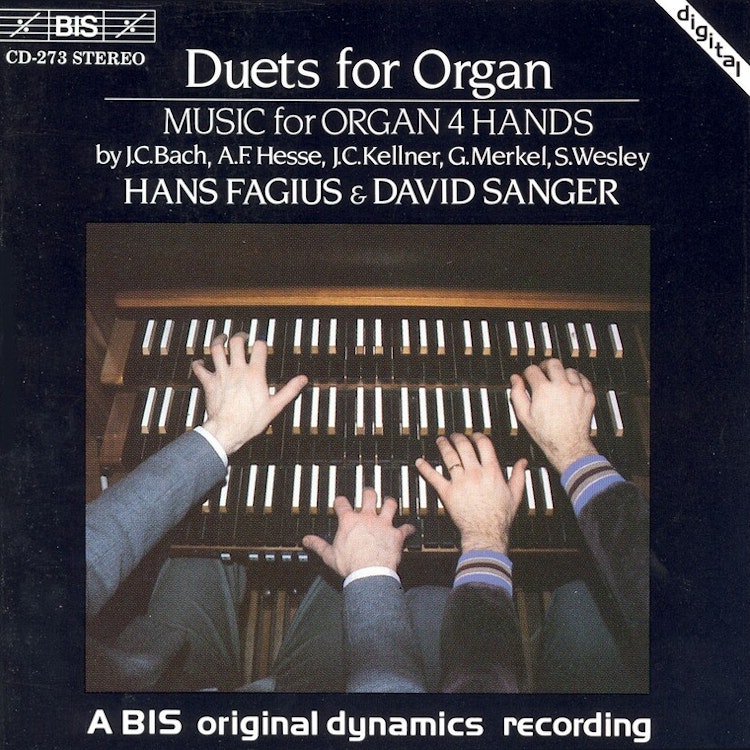
Bach, J.C. / Wesley / Hesse / Merkel: Duets for Organ
1/31/1986, 14 Tracks, 56:31
Featuring
Hans Fagius
David Sanger
Samuel Wesley
Adolf Friedrich Hesse
Johann Christian Bach
Gustav Adolf Merkel
Johann Christoph Kellner
Did you know?
1/7
Composer Biography
Johann Christian Bach, the youngest son of J.S. Bach, spent a large part of his life in London and significantly influenced the city's musical development.
Composer Biography
A.F. Hesse, one of the leading organists of his day, was mainly based in Breslau but frequently toured France and England, influencing organ technique in those regions.
Compositional Technique
Samuel Wesley's Grand Duet for organ features a characteristic blend of Classical, early Romantic, and conservative Baroque styles, and includes a crescendo made with the swell, a device found earlier in England than elsewhere in Europe.
Historical Context
Playing the organ four-handed, though now a curiosity, was a widely accepted practice in the late 18th and early 19th centuries, partly due to insufficient pedal compass on some organs for music by composers like J.S. Bach.
Composition History
Gustav Merkel's four-handed Sonata in D minor, Op. 30, won first prize in an 1857 competition advertised in the musical periodical Urania, marking his breakthrough as a composer.
Historical Context
English organs generally lacked pedals well into the 19th century, making four-handed playing a solution for performing much of the European Baroque repertoire.
Composer Biography
Samuel Wesley, a significant composer and leading English organist, was an enthusiastic advocate of J.S. Bach's music, even resulting in an edition of Das Wohltemperierte Clavier.
You might also enjoy...
Muffat: Works for Organ
Merula: Complete Works for organ
Französische Orgelmusik (Movimentos Edition)
Per la viola bastarda
Madrid Atrium Musicae: Three Centuries of La Spagna
Musica a Padova al tempo di Alvise Cornaro
Arias
Carlos V: Mille Regretz - La Canción Del Emperador
Jukkaslatar: Songs for Jukkasjarvi
Beschenkt (40 Miniaturen zum Jubiläum)
Bennett, R.R.: Suite of Old American Dances / Gershwin, G.: Rhapsody in Blue (American Tapestry)
In Memoriam Guillaume de Machaut: Messe Notre Dame