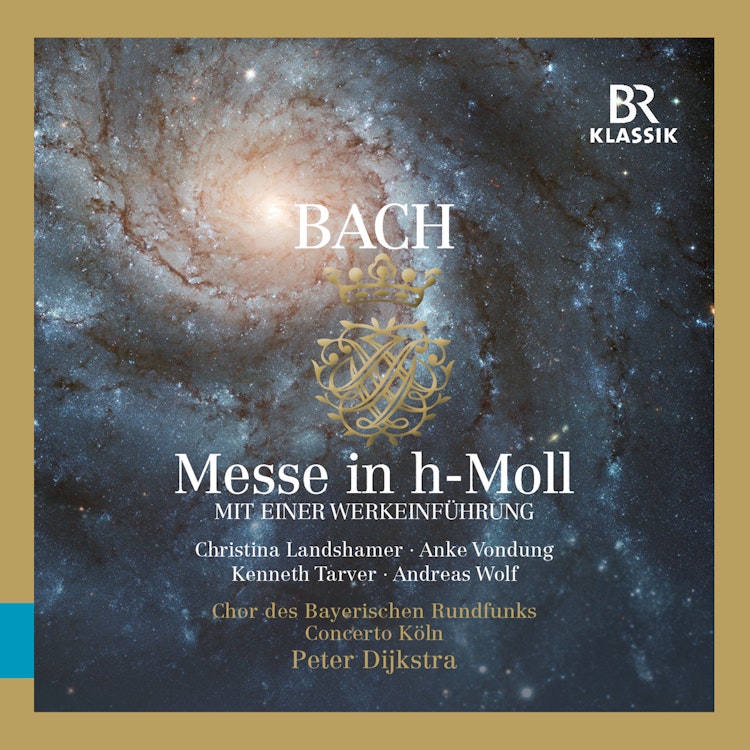
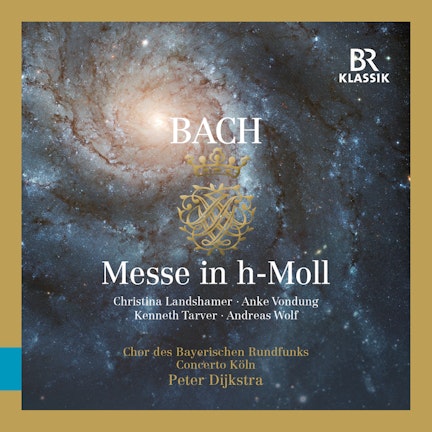
Bach: Mass in B Minor (With an Introduction to the Work)
2/3/2017, 45 Tracks, 2:58:41
Featuring
Christina Landshamer
Anke Vondung
Kenneth Tarver
Andreas Wolf
Peter Dijkstra
Christian Baumann
Gert Heidenreich
Hans Jürgen Stockerl
Chor des Bayerischen Rundfunks
Concerto Köln
Johann Sebastian Bach
Did you know?
1/7
Composer's Artistic Vision
Bach likely compiled his best works in the field of holy masses, supplementing them with new compositions or parodies, to create a comprehensive overview of his vocal and instrumental art.
Compositional Technique
Bach used the 'parody method' — reusing existing compositions in a new context — for several movements in the Mass in B minor, including the 'Osanna, Benedictus, Agnus Dei et Dona nobis pacem' section.
Critical Reception
In 1818, the Leipzig Allgemeine musikalische Zeitung described Bach's Mass in B minor as 'the Greatest Musical Work of All Times and All People' to attract subscribers for its first publication.
Composer's Artistic Vision
Bach saw the timeless model of the Mass, with its Latin text, as a suitable vessel to preserve his music for all times and peoples, transcending linguistic and religious barriers.
Compositional Technique
The 'Crucifixus' movement in Bach's Mass in B minor is a reworking of the opening chorus from his 1714 Cantata Weinen, Klagen, Sorgen, Zagen (BWV 12), with altered text, rhythmic structure, and an added four-bar ending.
Composition History
In 1733, Johann Sebastian Bach presented the elector Frederick Augustus II of Saxony with a Missa (Kyrie and Gloria) to recommend himself for a title at the Dresden Court Orchestra.
Compositional Technique
Bach's Mass in B minor demonstrates his 'Wißenschafft [...] in Musique' through mighty choirs, delicate chamber music, complex fugues, lyrical arias, expressive chromaticism, and skillful Baroque motoric elements.
You might also enjoy...
Bach: Weihnachtsoratorium (mit einer Werkeinführung)
Johann Sebastian Bach: Johannes-Passion, BWV 245
Bach: Mass in B Minor, BWV 232
Bach: h-Moll-Messe
J. S. Bach: Mass in B Minor, BWV 232
Bach: Mass in B minor/Lausanne Ensembles/Corboz
Bach: Mass in B minor
Ludwig Guttler And Peter Gulke Discuss Johann Sebastian Bach's Christmas Oratorio