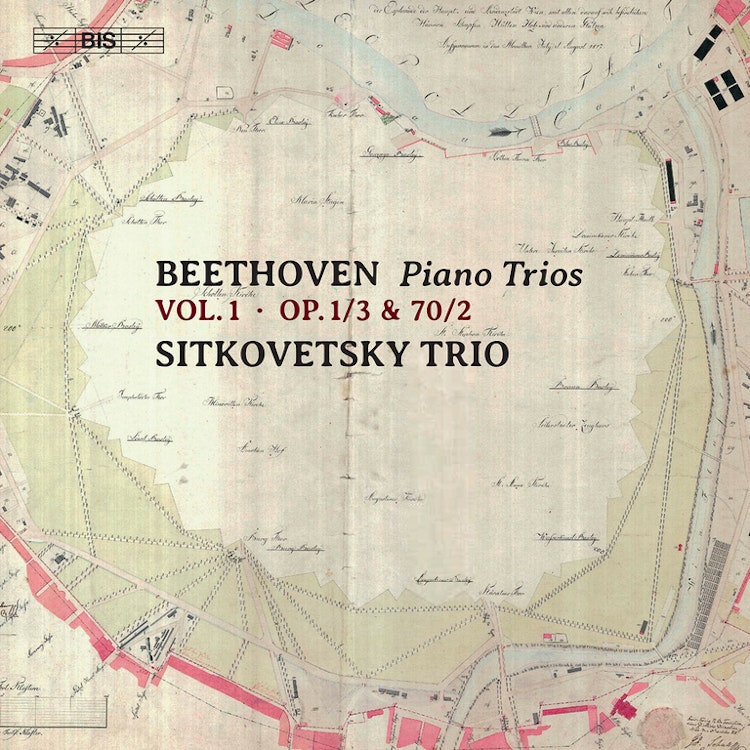
Beethoven's three piano trios, Op. 1, elevated the piano trio from salon entertainment to rival the string quartet, considered 'the most demanding form of chamber music'.
Performer Biography
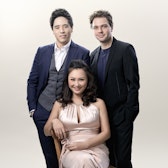
The Sitkovetsky Trio, formed in 2007, has performed in major concert halls across Europe, Asia, Australia, the USA, and Latin America, and has premiered new works by contemporary composers.
Compositional Technique
A compositional characteristic of late Beethoven, a tendency towards thematic unity, is already discernible in his early Op. 1 trios.
Compositional Technique
Beethoven's Op. 1 trios were innovative, increasing the number of movements to four by adding a scherzo or minuet, and giving the cello an independent role beyond a bowed keyboard bass line.
Critical Reception
The author and composer E.T.A. Hoffmann, a significant figure in Beethoven reception, praised the Op. 70 piano trios, stating they proved 'how Beethoven carries the Romantic spirit of music deep within his soul'.
Composition History
The Allegretto in B flat major, WoO 39, was Beethoven's last contribution to the piano trio genre, composed in 1812 for ten-year-old Maximiliane Brentano to encourage her piano playing.
Composition History
After the premiere of the Op. 1 trios, Beethoven's teacher Haydn advised against publishing the third trio, doubting it would be 'understood so quickly and easily' by the public.
You might also enjoy...
Prince Louis Ferdinand: Piano Quartet, Op. 6
Beethoven: Piano Trios op. 1,3 & 97
Beethoven: Piano Trios in C Minor and B-Flat Major, "Archduke"
Beethoven Piano Trios, Vol. 2
Beethoven: Gassenhauer Trio & Symphony No. 6
Beethoven: Piano Trios
Beethoven: Piano Trio No. 4 in B-Flat Major, Op. 11 "Gassenhauer"; Symphony No. 6 in F Major, Op. 68 "Pastoral" (Arr. for Piano Trio)
Louis Ferdinand, Prince of Prussia: Piano Trios, Opp. 3 & 10
Beethoven: Piano Trios, Op. 38 & Op. 81b
Beethoven: Ghost Trio & Triple Concerto
Beethoven: Piano Trios Nos. 5 ("Ghost") and 6, Op. 70