The 'Grosse Fuge' (Great Fugue), Op. 133, was originally intended as the closing movement for String Quartet No. 13, Op. 130, but was replaced due to its difficulty for performers and audiences.
Critical Reception
For decades after Beethoven's death, his late string quartets were considered obscure and impossible, with Vienna hosting only seven public performances in 25 years.
Performer Biography
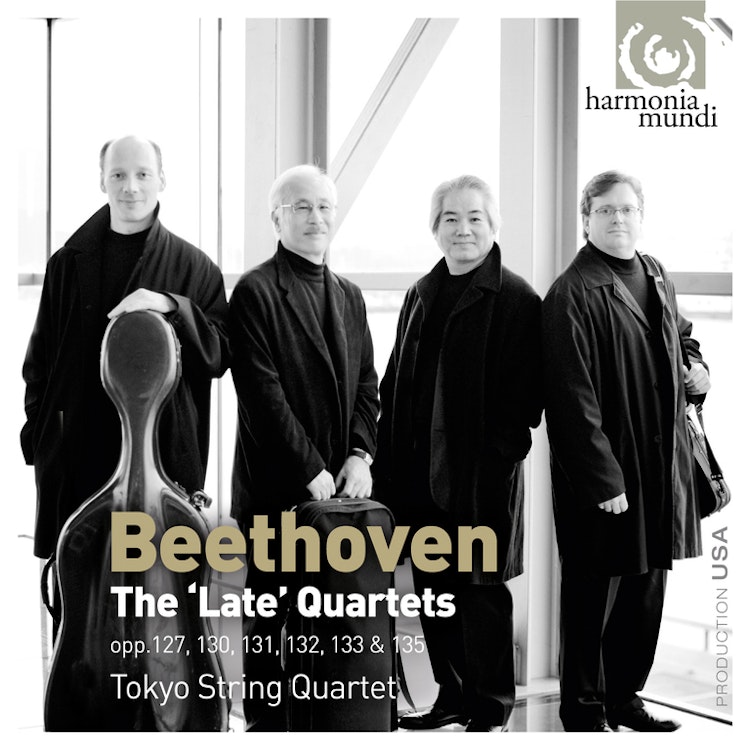
The Tokyo String Quartet, formed in 1969 at the Juilliard School of Music, traces its origins to the Toho School of Music in Tokyo, where its founding members were influenced by Professor Hideo Saito.
Composer's Artistic Vision
Beethoven's late quartets demonstrate a visionary approach, looking forward to new musical structures, backward to counterpoint and formal techniques like fugues, and inward to his own harsh experiences.
Recording & Production
This album marks the first time the Tokyo String Quartet has recorded in Japan, with parts of the late quartets captured at Tokyo's Oji Hall.
Composition History
Beethoven returned to composing string quartets in 1822 after a decade-long break, prompted by a request from Prince Nikolai Galitzin of St. Petersburg.
Instruments
The Tokyo String Quartet performs on 'The Paganini Quartet,' a set of renowned Stradivarius instruments named after the legendary virtuoso Niccolò Paganini, who owned and played them.
You might also enjoy...
The Auryn Series: Beethoven String Quartets, Vol. 4
Beethoven: The Late String Quartets
Ludwig van Beethoven: The Late Quartets
Beethoven: The Last String Quartets
Beethoven: The 5 Late Quartets & the Große Fuge
Beethoven: The Late String Quartets
Beethoven : Late String Quartets Nos 12 - 16
Beethoven: The Late Quartets, Opp. 127, 130, 131, 132, 133 (Grosse Fuge) & 135