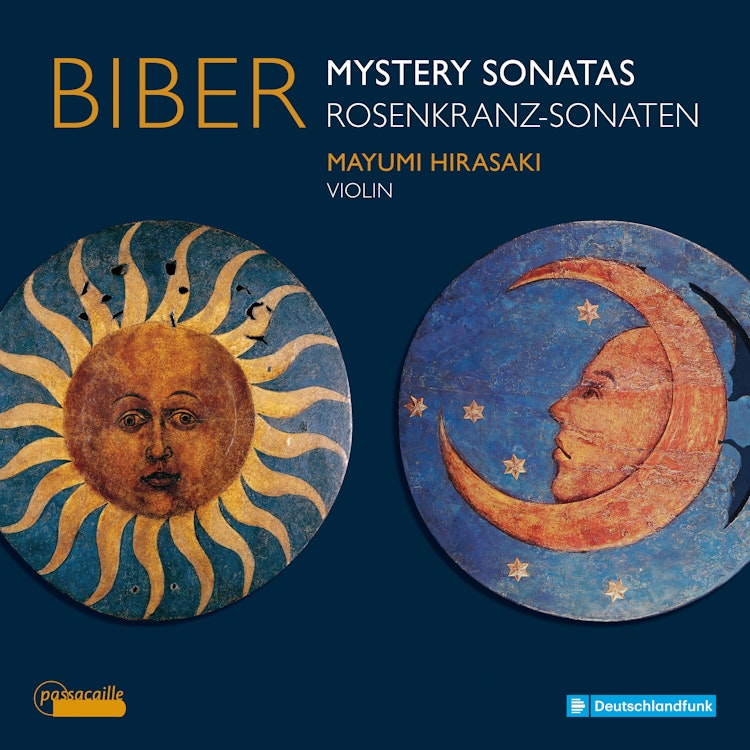
The manuscript of Biber's Mystery Sonatas, the only known source, was likely created around 1678, possibly as a gift to Max Gandolph von Kuenburg, who had promoted Biber to Vice-Kapellmeister that year.
Compositional Technique
Biber's Mystery Sonatas feature 'scordatura' tunings, where at least one violin string is tuned to a different pitch than usual, creating unusual fingering possibilities, chord progressions, and new tone colors.
Composer's Artistic Vision
Biber used court dances in these sacred works to ennoble the spiritual encounter of his prince-archbishop Max Gandolph von Kuenburg with the Son of God and the Mother of God.
Interpretation
For the Resurrection sonata, the violin's middle strings are reversed to form a cross shape, and the instrument imitates unison congregational singing with octave doublings.
Composition History
Biber composed these fifteen sonatas, known as the Mystery or Rosary Sonatas, in honor of the fifteen holy mysteries of the Rosary, dedicating them to his prince-archbishop Max Gandolph von Kuenburg.
Composer Biography
Heinrich Ignaz Franz Biber, a native of Bohemia, left his employer in 1670 and took up a position as a valet and musician at the Salzburg court in 1671.
You might also enjoy...
Fritz: Violin Sonatas, Op. 3
Jacquet de La Guerre: Violin Sonatas Nos. 1-6
Schenck: Suonate Per Violino E Violone O Cimbalo Op. 7, Vol. 2
Heinrich Ignaz Franz Biber: Rosenkranz-Sonaten
Johannes Schenk: Suonate Per Violino E Violone O Cimbalo Op. 7 - Vol. 1
Mystery (Rosary) Sonatas, Sonata No. 5 in A Major "The Finding in the Temple"
Handel: Violin Sonata in D Major, HWV 371: I. Affetuoso
Ariosti: Stockholm Sonatas for Viola D'Amore, Vol. 2
Mystery (Rosary) Sonatas, Sonata No. 6 in A Major "The Agony in the Garden"
Biber, H.I.F. Von: Mystery (Rosary) Sonatas
Pandolfi Mealli: Sonate à violino solo (Opera terza)