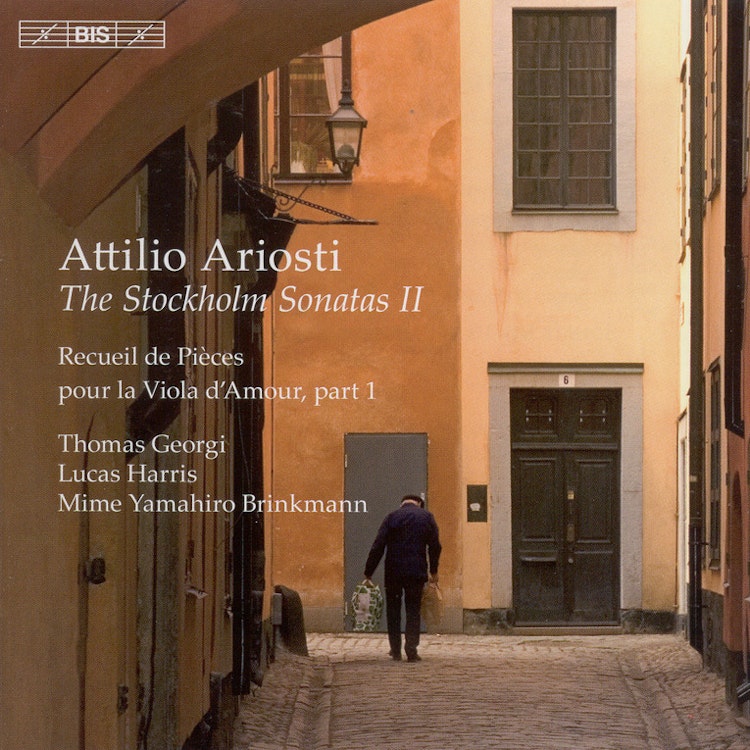
Ariosti: Stockholm Sonatas for Viola D'Amore, Vol. 2
5/1/2008, 25 Tracks, 56:32
Featuring
Thomas Georgi
Lucas Harris
Mime Yamahiro-Brinkmann
Attilio Ariosti
Did you know?
1/7
Composition History
The survival of 15 of Ariosti's viola d'amore solos is thanks to Johan Helmich Roman, a Swedish music student who copied them in London in the late 1710s.
Compositional Technique
Ariosti's harmonic boldness was admired by his contemporaries, with Rameau quoting a passage from his opera Coriolano as an outstanding example of enharmonic composition.
Interpretation
The performer, Thomas Georgi, assumes Ariosti used the viola d'amore as an alto range instrument and considered his scores as outlines for further embellishment, similar to Corelli's approach.
Composer Biography
Attilio Ariosti, born in Bologna in 1666 and died in London in 1729, was remembered by his contemporaries as a singer, organist, cellist, violinist, and writer of both drama and music.
Composition History
Ariosti's solos for the viola d'amore, totaling 21 pieces, constitute the largest single set of baroque works for the instrument.
Album & Artwork
All of Ariosti's viola d'amore solos are called the 'Stockholm Sonatas' in gratitude to Johan Helmich Roman, who copied them, and the Swedish library that preserved his manuscript.
Instruments
The viola d'amore used in this recording was made by Thomas Eberle in Naples in 1783, featuring 6 gut playing strings and 6 wire sympathetic strings.
You might also enjoy...
Ruhe vor dem Sturm und Drang
Marin Marais: Pièces De Viole Du Quatrième Livre
Marcello: 6 Cello Sonatas
Vivaldi : 6 Cello Sonatas
Mystery (Rosary) Sonatas, Sonata No. 6 in A Major "The Agony in the Garden"
Echoes of My Childhood
Geminiani: Sonatas for Violoncello & Basso Continuo
Italian concertos & sonatas
Vivaldi: Cello Sonatas
Handel: Works for Viola da gamba & Harpsichord
Out of Italy: Music of Antoniotti• Boccherini • Cervetto • Cirri • Geminiani • Lanzetti • Vivaldi
Vivaldi: 6 Sonatas Violoncelle Et Basse Continue
Bononcini: Cello Sonatas
Barrière: Six Sonatas For Cello and Basso Continuo