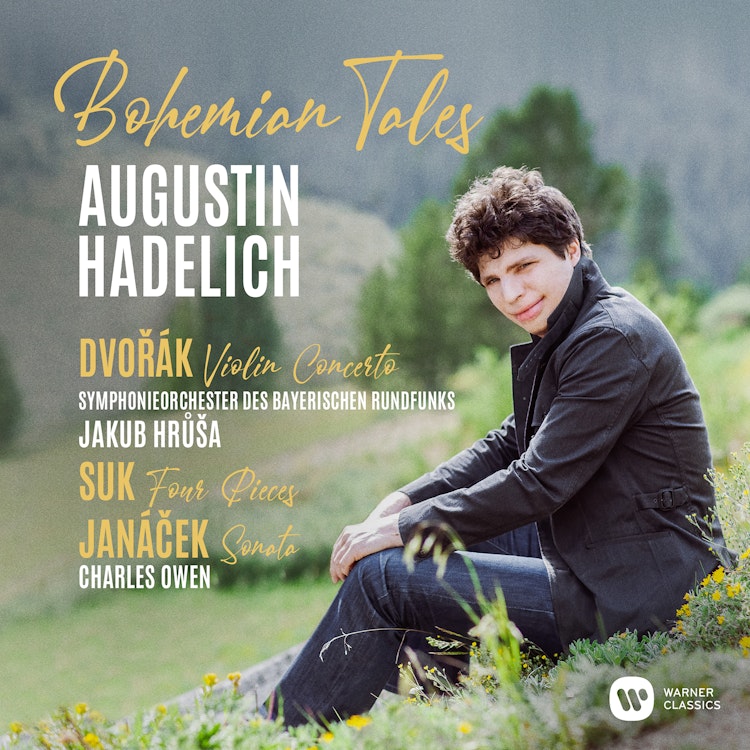
Violinist Augustin Hadelich gained great acclaim for his interpretation of the Dvořák Violin Concerto, and here records it alongside several chamber works that also have a Bohemian influence. For the concerto he is partnered by the Czech-born Jakub Hrůša and the Symphonieorchester des Bayerischen Rundfunks, while his pianist partner – for works including Janáček’s Sonata and Four Pieces by Suk – is Charles Owen.
Gramophone Editor's Choice
Featuring
Augustin Hadelich
Jakub Hrůša
Charles Owen
Symphonieorchester des Bayerischen Rundfunks
Antonín Dvořák
Leoš Janáček
Josef Suk
Did you know?
1/7
Historical Context
During the second half of the 19th century, many non-German composers in the Austro-Hungarian empire developed 'national' styles inspired by their homelands' languages, stories, landscapes, and folk music.
Composer Biography
Josef Suk, another composer on this album, was a pupil and son-in-law of Antonín Dvořák, but developed his own original compositional voice.
Compositional Technique
Janáček's music often features sudden mood changes and contradictions, such as writing a ritardando while shortening note values, or staccato notes with the sustain pedal pressed.
Composer's Artistic Vision
Leoš Janáček, another composer on this album, was deeply interested in Moravian folk tunes and, despite being ahead of his time, rejected atonality, stating, 'Folksong knows of no atonality'.
Historical Context
The region of Bohemia, now part of the Czech Republic, was an independent kingdom for centuries and a focal point of religious conflicts that led to the Thirty Years' War.
Composer Biography
Antonín Dvořák, a composer featured on this album, was himself a violist, which influenced the importance of inner voices in his scores.
Performer Biography
Augustin Hadelich, the violinist on this album, and pianist Charles Owen have been regular collaborators since 2010, sharing a deep and obsessive approach to musical details.
You might also enjoy...
Busoni: Violin Sonatas - 4 Bagatelles
Philipp Scharwenka works for Violin and Piano
Mendelssohn · Brahms · Grieg: Violin Sonatas
Notturno
Schubert: Complete Works for Violin and Pianoforte