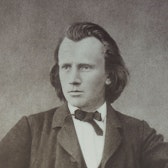
Brahms: Ein deutsches Requiem, Op. 45 (A German Requiem)
5/6/2014, 7 Tracks, 1:05:11
Featuring
Johannes Hiemetsberger
Johanna Gröbner
Veronika Trisko
Adrian Eröd
Elena Copons
Chorus sine nomine
Johannes Brahms
Did you know?
1/7
Performer Biography
Adrian Eröd, the baritone on this recording, achieved significant success as Sixtus Beckmesser in Wagner's Meistersinger von Nürnberg, leading to an invitation to the Bayreuth Festival.
Composer's Artistic Vision
Brahms's A German Requiem is not a traditional Catholic Requiem Mass; instead, it uses texts from Luther's Bible focusing on comforting the bereaved.
Recording & Production
This recording of Brahms's A German Requiem was made in October 2013 at the Franz Liszt Konzertsaal in Raiding, Burgenland.
Historical Context
In the 19th century, a special license was required to perform Brahms's A German Requiem in a church due to its controversial nature, as it omits direct mention of Jesus Christ.
Composition History
Brahms's A German Requiem was only completed in its seven-movement form in 1868, after Clara Schumann had seen an earlier piano excerpt in 1865.
Critical Reception
Despite being considered one of Brahms's most important works today, A German Requiem's first performances "absolutely failed" and caused a scandal.
Composer's Artistic Vision
Brahms intended the title 'A German Requiem' to be inclusive, stating he would have preferred to replace 'German' with 'human'.