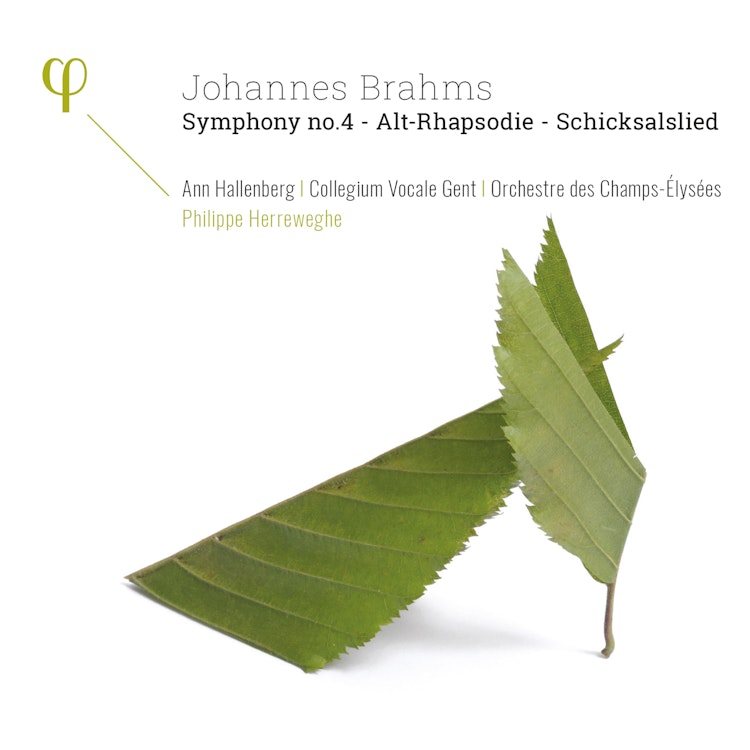
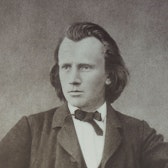
Brahms avoided writing a symphony for many years, feeling intimidated by the legacy of Beethoven, whom he called a "giant marching behind you."
Interpretation
The Orchestre des Champs-Élysées and Collegium Vocale Gent, the performers on this album, have a shared aesthetic that emphasizes rhythmic precision, non-tempered intonation, and text-driven phrasing.
Composition History
Brahms composed his 'Alto Rhapsody' in anger and fury after learning of the engagement of Julie Schumann, the daughter of Clara Schumann, with whom he was in love.
Compositional Technique
The finale of Brahms's Fourth Symphony is a chaconne, a Baroque form, where an eight-measure theme is repeated thirty times as the basis for variations, fusing ancient and modern practice.
Composer's Artistic Vision
Johannes Brahms, the composer, was deeply influenced by poetry and text, seeing his entire body of work as an organic continuation of earlier music, particularly that of Schütz and Bach.
Compositional Technique
Brahms's Fourth Symphony has a tight musical structure based largely on the interval of a third, which appears in many themes and influences the harmonic plan.
You might also enjoy...
George Lloyd: The Vigil Of Venus (Pervigilium Veneris)
Berlioz: Roméo et Juliette
Eliasson: Quo Vadis
Brahms: Song of Destiny (Shicksalslied)
Berlioz: Roméo et Juliette
Sallinen, A.: Songs of Life and Death / The Iron Age Suite