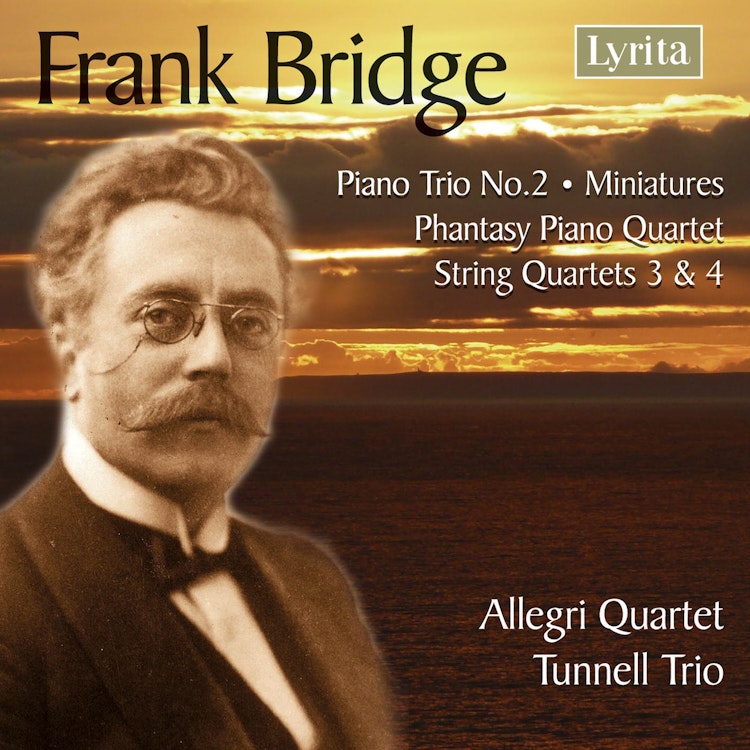
Bridge: Piano Trio No. 2 - Miniatures for Piano Trio - Phantasie - String Quartets Nos. 3 & 4
10/1/2007, 14 Tracks, 1:44:33
Featuring
Hugh Maguire
David Roth
Patrick Ireland
Bruno Schrecker
John Tunnell
Charles Tunnell
Susan Tunnell
Brian Hawkins
Allegri Quartet
Tunnell Trio
Frank Bridge
Did you know?
1/7
Composer Biography
Before World War I, Frank Bridge was as well known for his viola playing in the English String Quartet as he was for his compositions.
Compositional Technique
Frank Bridge's String Quartet No. 4, though not atonal, features a harmonic language dominated by a polychord: a major triad superimposed on a minor triad with a root one tone lower.
Composer's Artistic Vision
Frank Bridge believed his later works, which had no clear keys and irregular rhythms, were a natural progression from his earlier, more tonal music, stemming from a desire to express more personal and subtle ideas.
Composition History
The American patron of new music, Elisabeth Sprague Coolidge, provided Frank Bridge with $2,500 a year, enabling him to focus on composing in new stylistic paths.
Composer Biography
Frank Bridge's music, particularly his chamber and orchestral works composed between 1924 and 1938, largely fell out of the repertoire after his death.
Critical Reception
Frank Bridge's Piano Trio (1929) received a cold reception in England, with critic Herbert Hughes calling it "patently 1929 music" owing a great deal to Schoenberg.
Composition History
Frank Bridge repaid Elisabeth Sprague Coolidge's generosity by composing works for her international festivals, including the String Quartet No. 3, Piano Trio (1929), and String Quartet No. 4 (1937).
You might also enjoy...
Dmitri Shostakovich: Chamber music
Harbison: Piano Trios / Gatsby Etudes / The Violist's Notebook / 10 Micro-Waltzes
Block: Chamber Works
Eric Zeisl: Chamber Music
Copland: Vitebsk / Bernstein: Piano Trio / Piazzolla: Las Cuatros Estaciones Portenas / Collon: N
Enescu: Piano Trio, Piano Quintet & Aria and Scherzino
Mozart: The Piano Quintets & Quartets
Tcherepnin, A: Suite for Solo Cello, Duo for Violin and Cello, Piano Trio, String Quartet No. 2 & Piano Quintet
Hoffmeister's Magic Flute, Vol. 1 (Live)
Beethoven: Chamber Works
Sergei Prokofiev: Humoresque Scherzo, Classical Symphony, Overture on Hebrew Themes, Quintet in G Minor & Romeo and Juliet
Shostakovich: Piano Quintet Op. 57, Piano Trio No. 2 & 4 Waltzes