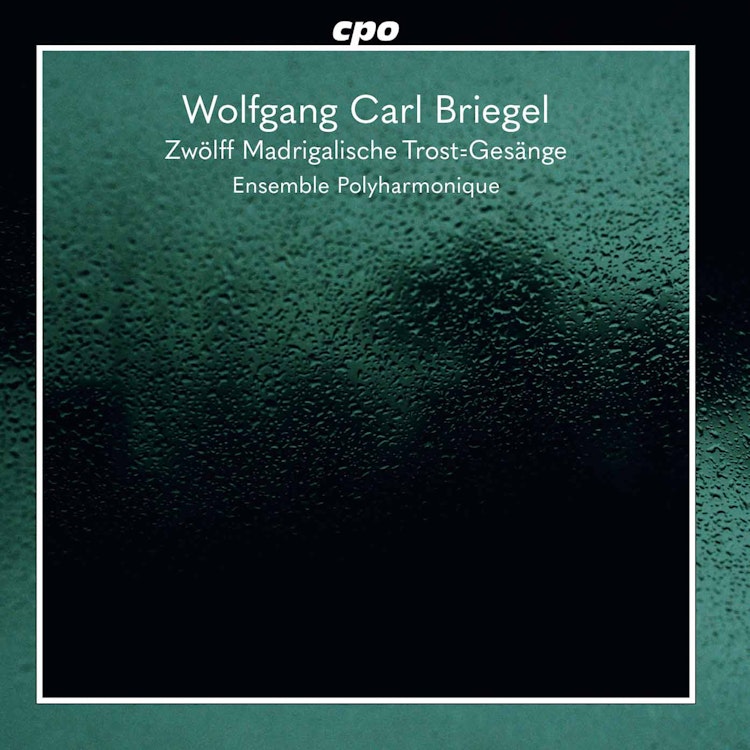
Briegel: Zwölff madrigalische Trost-Gesänge & Fugen durch die 8 Kirchentöne
5/6/2022, 20 Tracks, 1:02:10
Featuring
Klaus Eichhorn
Ensemble Polyharmonique
Wolfgang Carl Briegel
Did you know?
1/7
Composer Biography
Wolfgang Carl Briegel (1626-1712) received his initial musical training in Nuremberg under Johann Andreas Herbst (1588-1666) and was exposed to the latest Italian compositional styles.
Compositional Technique
Briegel's "Trost-Gesänge" collection includes various approaches to text setting, from "Spruchmotetten" where each phrase gets unique musical treatment, to hybrid styles combining motet and homophonic chorale settings.
Composition History
Wolfgang Carl Briegel (1626-1712) published his "Zwölff madrigalische Trost-Gesänge" in 1671 as a solemn farewell to his sovereign, Ernst I, Duke of Saxe-Gotha, after over two decades of service.
Instruments
The Ehrlich organ in Markt Nordheim, built in 1786, was restored to its original state (2017-2019) and has a higher tuning (A=473 Hz), requiring some pieces to be transposed downward for this recording.
Composer Biography
Wolfgang Carl Briegel (1626-1712) was responsible for the musical education of Duke Ernst I's children, but tragically, three of his young pupils died during a smallpox outbreak in 1657.
Interpretation
Ensemble Polyharmonique has arranged Briegel's "Trost-Gesänge" to reflect a baroque proportion, with the first half mirrored in the second, centered around the Latin-texted "Si bona suscepimus."
Historical Context
Ernst I, Duke of Saxe-Gotha (1605-75), also known as 'the Pious,' was a devout Lutheran and reformer who offered refuge to Lutherans fleeing persecution and implemented a progressive School Ordinance in 1642.
You might also enjoy...
J. S. Bach: Dritter Theil der Clavier Übung
J.S. Bach: Clavier übung, Dritter Theil
Bach: Clavier-Übung III
Bach: Die Kunst der Fuge
Bach: Clavierübung III, Vol. 1
J.S. Bach - Clavierübung III - L'offrande musicale
Bach: The Trio Sonatas
Bach: Trio Sonatas
Bach: Clavierübung III, Vol. 2
Bach: Klavier-Übung III
50°53'53.9"N 10°33'22.6"E (Bach Organ Landscapes / Waltershausen)