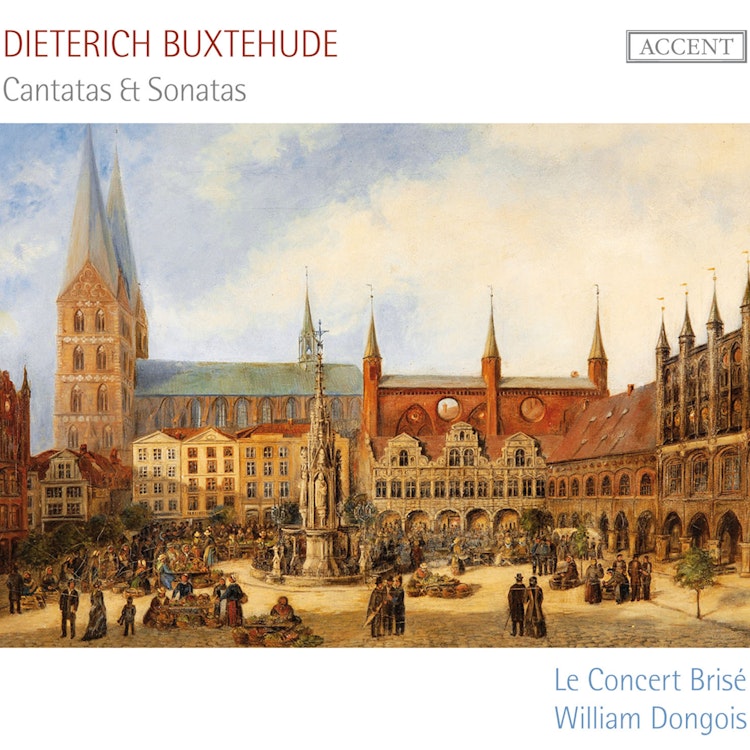
A large portion of Buxtehude's vocal compositions are preserved in the Düben Collection at Uppsala University Library, showcasing the significant musical exchange across Europe during his time.
Instruments
The instrumentation for this recording was chosen to give a specific 'North German' tonal flavoring, featuring instruments like violin, cornett, trombone, and bassoon.
Composer Biography
Dieterich Buxtehude, an organist in Lübeck, is known as a predecessor of Johann Sebastian Bach, who traveled 400 kilometers to study with him.
Interpretation
Le Concert Brisé, the ensemble on this recording, uses musicology to understand the spirit of the music and incorporates improvisation techniques from jazz and traditional music.
Compositional Technique
Buxtehude's music is considered the culmination of the 'stylus fantasticus' style, which originated from Italian music between 1620 and 1640.
Composer's Artistic Vision
Buxtehude's work is deeply rooted in the Italian tradition and also shows a strong receptiveness to the French style, which was gaining influence.
Composition History
Most of Buxtehude's works survived only through a few manuscripts, as few were printed during his lifetime, leading to their gradual rediscovery.
You might also enjoy...
J.S. Bach: Sinfonias from Cantatas
Attaingnant / Playford / Lully / Mozart: Court Dance in the 16th to 18th Centuries
Pietro Marchitelli, Trio Sonatas
Con spirito
Josquin, the Undead: Laments, Deplorations & Dances of Death
Bach: Cantatas, Vol. 11
Dreyer: Sacred Music
Vitali: Sonatas, Op. 11 for Violin and Basso Continuo
Marais: Troisième livre de pièces de viole
Klangraum Kloster Maulbronn: Bach Meets Vivaldi (Live)
Venice and Beyond: Concerti da Camera & Sonate Concertate for Woodwind Instruments