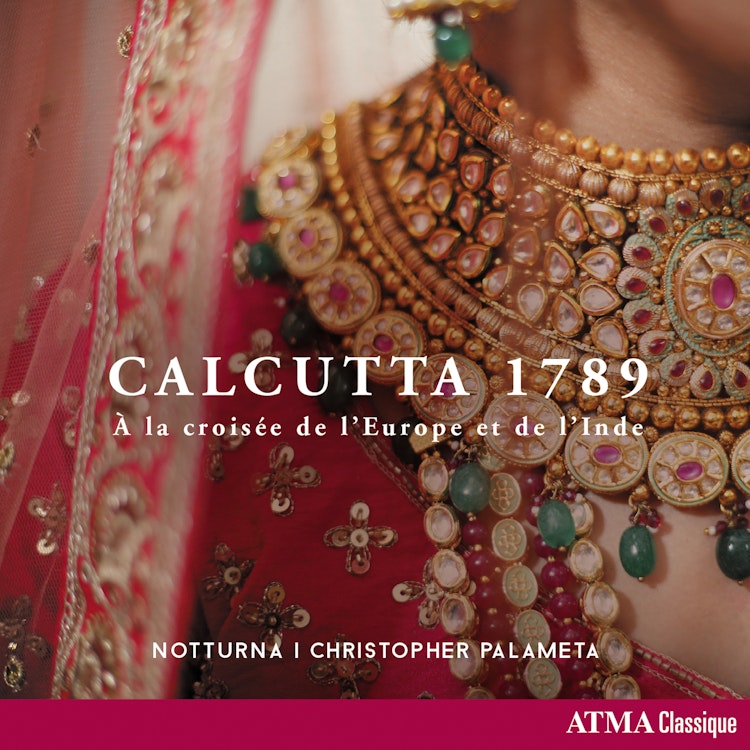
Calcutta 1789 - À la croisée de l'Europe et de l'Inde
6/2/2023, 18 Tracks, 1:05:16
Featuring
Christopher Palameta
Mika Putterman
Olivier Brault
Dorian Bandy
Susie Napper
Brice Sailly
Uwe Neumann
Shawn Mativetsky
Ensemble Notturna
Anonymous (Traditional)
Johann Christian Bach
George Frideric Handel
Henry Purcell
Carl Friedrich Abel
Anonymous
Did you know?
1/7
Composer Biography
Carl Friedrich Abel and Johann Christian Bach, both German musicians, established the 'Bach-Abel' concerts in London's Soho Square in 1765.
Compositional Technique
European transcribers of Indian music, like Sophia Plowden and Margaret Fowke, faced challenges due to Indian music's use of quarter tones, complex rhythms, and non-tonal harmony.
Cultural Impact
The popularity of Hindustani airs in Calcutta marked one of the first instances of Western classical music engaging with a 'world music' genre.
Interpretation
The opening track, 'Sakia,' is a Hindustani melody transcribed by Margaret Fowke, structured like an 18th-century 'jam session' with instruments joining one by one.
Historical Context
Wealthy British merchants, known as 'nabobs,' often traveled to India for years or decades with lavish entourages that included private musicians.
Cultural Impact
King Serfoji II of Thanjavur (1777-1832) was an Indian composer and collector who acquired European musical instruments and scores, amassing 306 works now in the Sarasvati Mahal Library.
Historical Context
Calcutta, a trading post founded by the British East India Company in 1609, was a vibrant cultural crossroads where Eastern and Western arts intertwined, especially in the late 18th century.