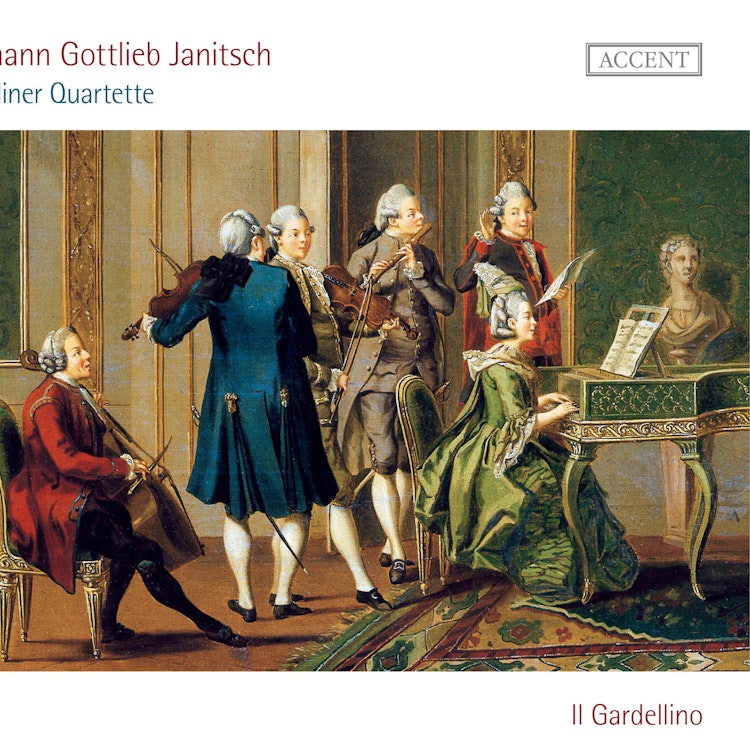
Janitsch founded and directed a private music academy, the 'Friday Academy,' in Rheinsberg and later in Berlin, for which most of his quartet compositions were written.
Compositional Technique
Janitsch's quartets are notable for their expressive style, original themes, rich harmonies, syncopated rhythms, and refined ornamentation techniques.
Historical Context
King Friedrich II of Prussia, a flutist and composer, ensured music was an unprecedentedly significant part of courtly life in Berlin, fostering a "golden age" of music.
Compositional Technique
In the late Baroque era, quartets were considered a demanding 'supreme discipline' of chamber music, a 'touchstone of a genuine contrapuntist,' according to Johann Joachim Quantz.
Compositional Technique
The Quartet in G minor for oboe, violin, viola, and basso continuo uses a chorale setting technique, with its third movement based on the melody of 'O Haupt voll Blut und Wunden'.
Critical Reception
Twenty years after Janitsch's death, composer Johann Wilhelm Hertel praised his quartets as "still now the best examples of their kind."
Composer Biography
Johann Gottlieb Janitsch, a double bassist in King Friedrich II's court orchestra, studied law before becoming a musician and secretary to a Prussian state councilor.
You might also enjoy...
Telemann, G.P.: Essercizii Musici - Solos and Nos. 7-12
Telemann: Trio Sonatas
Beauteous Softness
Westhoff: Sonates pour violon & basse continue
Neapolitan Concertos for Various Instruments
La bellezza: The Beauty of 17th Century Violin Music