Pianos in the 18th century were highly individual works of art, differing significantly from town to town and builder to builder, unlike the standardized instruments of modern times.
Historical Context
From about 1770 to 1870, two distinct schools of piano building, 'English' and 'Viennese' fortepianos, competed for the favor of musicians and audiences.
Composer's Artistic Vision
The unique characteristics of the English piano, such as its legato touch and richer tone, inspired composers like Johann Ladislaus Dussek and John Field to write long, singing cantabile melodies.
Compositional Technique
Johann Ladislaus Dussek's Sonata Op.35 No.3 stands in a tradition of C minor fantasies and sonatas, preceding and sharing characteristics with Beethoven's 'Pathétique' Sonata Op.13.
Instruments
English pianos, unlike Viennese ones, often featured a damper pedal from the early 1780s, while Viennese pianos used a knee lever until after 1800.
Composition History
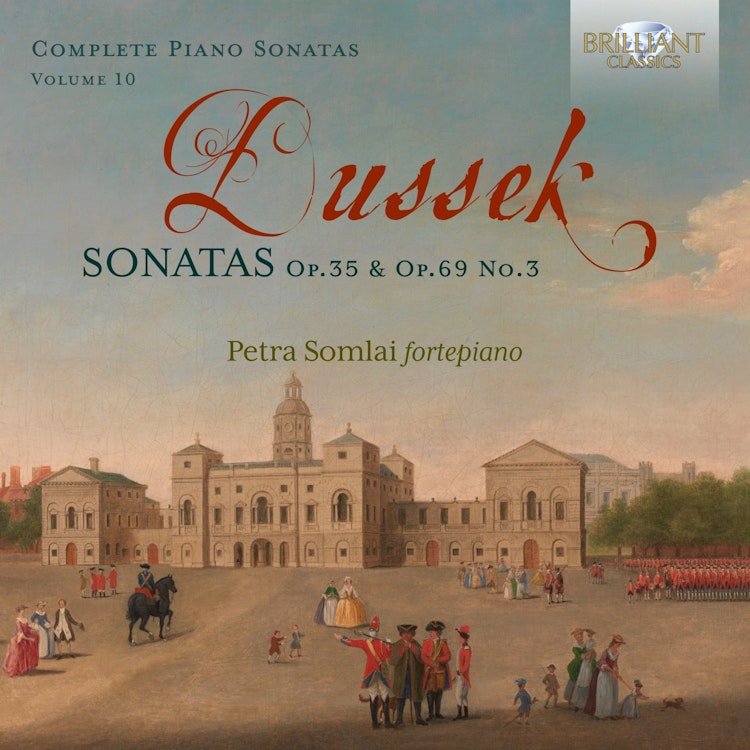
The three Sonatas Op.35 by Johann Ladislaus Dussek were composed in 1797, a difficult year for the composer who was experiencing marital problems and financial debt.
Cultural Impact
Ludwig van Beethoven, a contemporary composer, owned copies of Johann Ladislaus Dussek's sonatas and found inspiration in them, with striking thematic similarities noted between their works.
You might also enjoy...
Dussek: Complete Piano Sonatas, Op. 14 Nos. 1-3, Vol. 9
Hummel: Piano Sonatas, Vol. 2
Richter plays Haydn/Weber/Beethoven
Walter Gieseking Plays Mozart & Beethoven
A New Path
Clementi, M.: Early Piano Sonatas, Vol. 2
Ludwig van Beethoven: The Complete Piano Sonatas Vol. 7
Sviatoslav Richter at Carnegie Hall, New York City, December 23, 1960
Beethoven: The Complete Piano Sonatas, Vol. 2
Young-Choon Park: Recital Series, Vol. 1 - Live at Kungsbacka Concert Hall