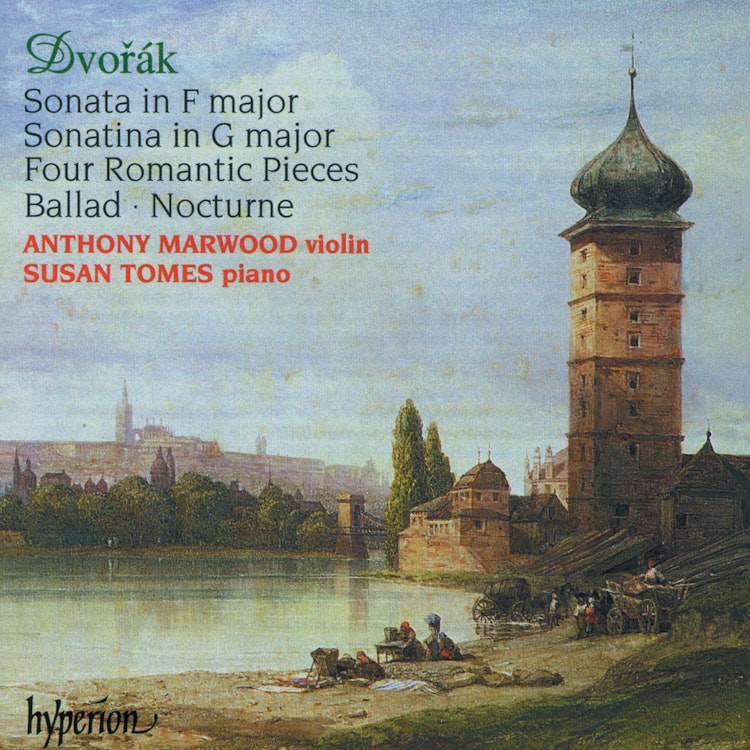
Dvořák: Music for Violin & Piano – Sonata; Sonatina; 4 Romantic Pieces etc.
10/13/2023, 13 Tracks, 1:07:00
Featuring
Anthony Marwood
Susan Tomes
Antonín Dvořák
Did you know?
1/7
Composer Biography
Dvořák found immense pleasure in writing smaller works, comparable to composing a great symphony, as evidenced by his Bagatelles for two violins and viola.
Composition History
Dvořák's early Sonata in A minor of 1873 is lost, though its first performance was extensively praised by the musical magazine Dalibor.
Composition History
The Sonatina in G major was intended as a gift for Dvořák's children, Otilka and Antonín, and its simplicity made it popular for young musicians.
Composition History
The Notturno in B major has a complex history, originating as the slow movement of Dvořák's String Quartet in E minor, then revised for a string quintet, and finally arranged for string orchestra and for violin and piano.
Composition History
The Ballad in D minor was composed specifically for the Christmas edition of the London Magazine of Music in 1884, following Dvořák's growing international reputation.
Composition History
The Four Romantic Pieces were originally composed as the Terzetto in C major, but Dvořák rearranged them for violin and piano after the original proved too difficult for an amateur violinist.
Composer's Artistic Vision
During his time in America, Dvořák simplified the general shaping of movements, allowing him to focus on melodic inspiration.
You might also enjoy...
Fauré: Sonatas for Violin and Piano
Bohemian Tales
Röntgen: Works for Violin & Piano, Vol. 1
Grieg, A.: Piano Music, Vol. 7
Strauss & Respighi: Violin Sonatas
Reger: Violin & Piano Works, Vol. 2
Nápravník: Chamber Music, Vol. 1
Gabriel Fauré: Complete Works for Violin and Piano
Schumann: Violin Sonatas Nos. 1 & 2
Three Sonatas For Violin And Piano (Trois Sonates Pour Violon Et Piano)