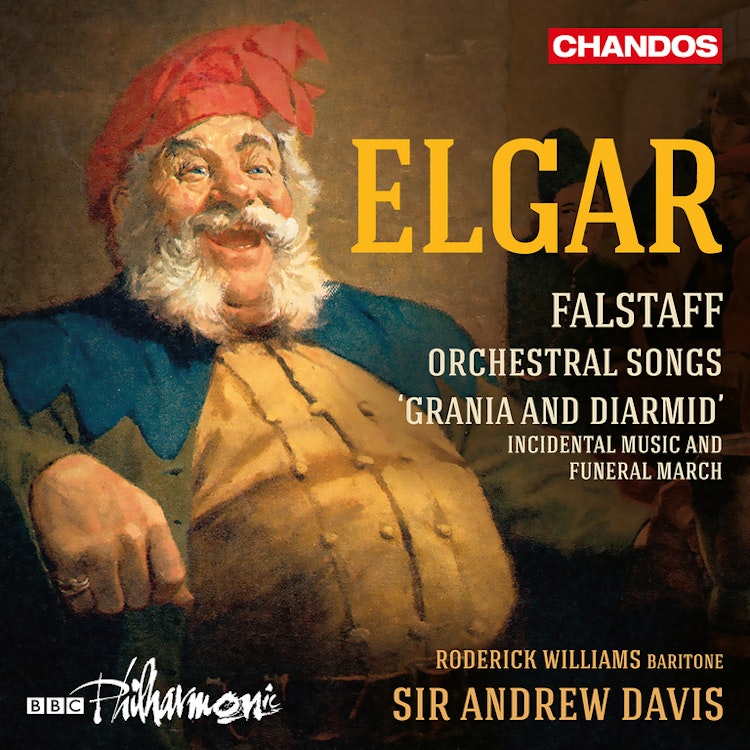
Elgar: Falstaff, Orchestral Songs and Grania & Diarmid
11/3/2018, 18 Tracks, 1:05:36
Featuring
Sir Andrew Davis
Roderick Williams
BBC Philharmonic
Edward Elgar
Gilbert Parker
George Augustus Moore
Did you know?
1/7
Composition History
Elgar began working on his 'symphonic study' Falstaff in March 1913, inspired by Shakespeare's portrayal of the complex and tragic figure.
Composer's Artistic Vision
Elgar viewed Falstaff as more than just a character study, stating to Ernest Newman that 'Shakespeare - the whole of human life - is the theme'.
Composition History
Elgar's 'Kindly do not SMOKE' is a musical jest, inspired by his friend Edward Speyer reprimanding him for smoking, and features a grandiose setting of the phrase 'Kindly, kindly, kindly do not SMOKE in the hall or staircase!'.
Compositional Technique
Falstaff is structured as a single four-part movement with interludes, and Elgar assigns three themes to Falstaff and one to Prince Hal to musically portray their characters.
Composition History
Elgar composed the 'Funeral March' for Grania and Diarmid before even reading the play, at the request of Anglo-Irish novelist George Moore, who collaborated with W.B. Yeats on the play.
Critical Reception
Falstaff received a less than rapturous reception at its 1913 premiere, with Elgar's wife noting he was 'very depressed after'.
Composer Biography
Elgar's song 'The Wind at Dawn' sets a poem by his future wife, Caroline Alice Roberts, and won first prize in a competition.
You might also enjoy...
Schubert: An Sylvia, D. 891 (Arr. Schmalcz for Baritone and Chamber Orchestra)
Britten: Our Hunting Fathers, Op. 8
Respighi: La Sensitiva / La Pentola Magica / Aretusa